Showing posts with label AIDS. Show all posts

Tuesday, April 7, 2015

HIV/AIDS in Uganda


Last week I gave an HIV/AIDS Education Workshop at the primary school for the staff. It was something they had requested as they felt the need to educate their pupils more in this area. In fact, it’s actually an area I needed more education about before Peace Corps too. I watched Philadelphia in school, I knew some of the history of it in the U.S. (mostly thanks to Rent), I knew that HIV/AIDS was "bad in Africa" (and that’s probably one of the world’s most general statements ever), but I didn’t know much more than that. It seemed like a far-off, ancient problem - in my fairly sheltered American life, I had never even met anyone who had HIV or AIDS. Coming to Uganda, that all changed. Peace Corps provided me with the most thorough education on this subject that I had ever received, an education that seemed much more relevant and needed as I began to get to know more co-workers, students, and friends for whom HIV/AIDS had intimately, awfully, impacted their lives.

Uganda actually was considered a success story in sub-Saharan Africa when it came to HIV/AIDS, reducing the rate from up to 30% in the 1990s to 6.4% in 2006. Much of this has been credited to an extensive education program in the 90’s using the ABC approach: Abstinence, Be Faithful, Use Condoms. However, HIV prevalence has been on the rise again since 2006. Approximately one in 10 women now become HIV positive by their late 30s and for men, about one in 10 are infected by their early 40s. This is in part due to the government’s shift, somewhat under pressure from foreign countries like the U.S., towards abstinence-only programs during the 2000’s. Some health experts also blame the increasing rate of infection on “AIDS-fatigue,” a general complacency and reduction in safe sex that began once Uganda started to be lauded as a victor in the battle against HIV/AIDS.

Right now, 1.4 million people in Uganda are living with HIV, and, despite the nation’s early success in combating HIV/AIDS, there are 1.1 million children that have been orphaned by this epidemic. Many of my own pupils are part of this statistic. They live with extended family, adults who find it difficult to pay for their own children’s school fees, uniforms, and meals, not to mention doing the same for other young relatives, but nevertheless take them in.

Working to educate youth about HIV/AIDS is extremely important in Uganda, not only because HIV/AIDS is more prevalent here, but also because the median age is 15 (15!). With so many youth and so few adults, accurate facts and means of prevention can slip through the cracks and be replaced by rumors and misconceptions. HIV/AIDS and sex education are clearly urgently needed right now; only 39 percent of young people aged 15 to 24 know all the necessary facts about how HIV can be prevented. National prevention and treatment efforts also need to be supported, requiring a de-stigmatization of those living with HIV. Stigma and discrimination against people with HIV is still common in many rural areas, so even those who know their or their children’s positive status are reluctant to seek help for fear of “outing” themselves or their family members. The passage of the HIV and AIDS Prevention and Control Act in Uganda, which sanctions forced disclosure and criminalizes transmission, attempted transmission, and “behavior that might result in transmission,” is only continuing to add to this problem.

In Peace Corps, and at my school, Ugandans and PCVs are continuing the fight from the ground up, working with people who can help affect some of the most change: teachers. In fact, a quarter of the people who are living with HIV in Uganda right now are a part of the school system - students or staff. At the workshop last week, we refreshed the basics, talked about incorporating literacy into HIV/AIDS education, discussed how gender roles can affect the spread of HIV/AIDs, detailed how to care for people with HIV, and played a lot of games and activities that the teachers can do with their pupils. During the games and activities, such as Jeopardy, foot races, Big Books, and play-acting, we also did some myth-busting. And man, are there some wildly inaccurate myths out there (and probably in the States too, unfortunately): condoms cause cancer; virgins can’t have HIV; having sex with a virgin will cure you; when an HIV+ mother breastfeeds, the baby dies; HIV can be transmitted by mosquitoes; washing out with Coca-Cola after sex will prevent you from being infected; HIV can be passed by kissing; America has a secret cure for HIV/AIDS; America invented HIV/AIDS (oh, conspiracy theories!). 

The teachers got extremely competitive during the final Jeopardy review!

One of the pre-assessments, where the average score was 70; everyone scored 100 or 95 on the post-assessments.


Doing a "Can Transmit" and "Cannot Transmit" activities sort - it's not every day that you get to explain to your coworkers the definition of pre-ejaculate in English...


Overall, I like to think the workshop was a success – the pre- and post-assessments on HIV/AIDS I gave out showed drastic improvement, and the teachers were excited (and very competitive!) while practicing a variety of ways to educate their pupils on HIV prevention, treatment, and care. I’m looking forward to seeing the teachers use their new skills to give the kids an opportunity to play and learn at the same time. It is just a start, and a small one at that, but it's one I was proud to be asked to be a part of.


There is a saying in Tibetan, "Tragedy should be utilized as a source of strength." No matter what sort of difficulties, how painful experience is, if we lose our hope, that's our real disaster.
- Dalai Lama

Friday, August 15, 2014

Maude's Story


Maude showed up at our door that Sunday to take us to her home, her brother beside her on a bicycle, bearing a bunch of green bananas and a bright blue basin full of jackfruit and avocados. She was there to bring us to her home and show us her new business, an apiary she started two years ago.

We walked along the road towards her village, Kris carrying the empty basin she had brought us food in. We passed by two women digging in the fields, just back from church in their best kitenge. Maude went to greet them and came back with the basin, now full of Ugandan sweet potatoes, balanced on her head. Laughing at Kris’s offer to keep carrying the basin, his ability to carry it while full of potatoes clearly hilarious, Maude led us onward, branching at a dirt path leading deeper into the hills. While we walked, Maude asked us what Americans know about Uganda, and I struggled to find a way to tell her that the only things most Americans associate with Uganda are Idi Amin, AIDS, and the nickname of the Pearl of Africa…if that.

As we paused on top of one of the lush green hills, a small girl approached us. Maude explained that Shivan was actually her niece, but Maude has been taking care of her since her mother died. She handed over the apparently too-heavy-for-Kris basin full of potatoes to the eight-year-old with instructions to run ahead and begin the preparation for lunch. As Shivan balanced the basin on her head and nimbly moved ahead, Kris and I took a moment to exchange a glance and a laugh at Ugandans’ constant low estimation of our physical abilities.

We stopped one more time as Maude pointed out her village. It is small, with perhaps a couple dozen homes scattered across the rolling land and a one-building trading center where the villagers can buy soap and other necessities. As we climbed the last hill to Maude’s house, we paused at the top and she pointed out the lines of the property her family has held for generations, spreading out over banana plantations and sprawling fields.

We entered Maude’s compound, a cleanly swept dirt area consisting of three different buildings. The first contains a sitting room and several bedrooms, while the second contains a storage room and more bedrooms for the variety of children that live there, beds piled high with foam mattresses and the ubiquitous Ugandan blankets. The last is a kitchen separated into a cooking area and an eating area with a dirt floor covered in grass. Maude pointed out the nesting chickens in the corners of the kitchen; this is where they lay their eggs when they are ready. She then brought us around the corner and showed us the neighboring mud and wood constructions housing hundreds of goats and chickens.

After the tour, Maude introduced us to her aging mother, various nieces and nephews, and her grandnephew. Kris and I settled into two wooden chairs brought outside for us, playing peek-a-boo with the grandnephew. We were presented with about a dozen bananas and told that we were expected to finish them while Maude bustled around, preparing for lunch, slaughtering a chicken, shooing the dog out of the kitchen, and instructing her nieces. Once she was satisfied that the meal she had begun over the open wood fires in her kitchen could be continued by her family without her direct supervision, she took us to see her apiary.

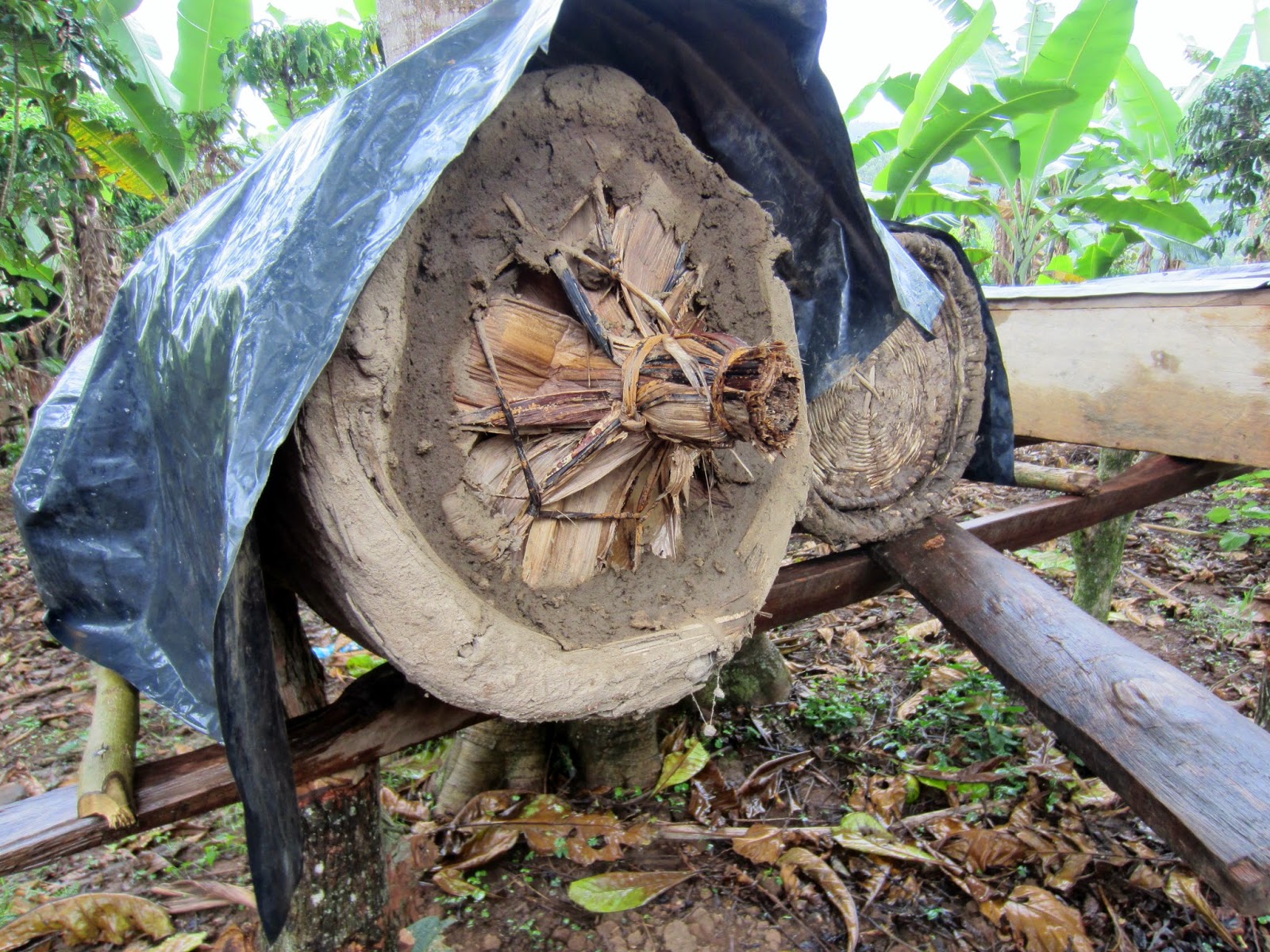
Maude began her apiary as an income-generating activity two years ago with only the help of a local boy whom she is able to pay, as she says, “not nearly enough.” With almost no knowledge of beekeeping, she managed to produce almost 100 liters of honey in her first year using traditional methods such as hand-held smokers and hive baskets she wove herself. She admitted to us that she is still learning as she goes; her first year, she threw away all of the empty comb, having no idea she could sell it at a profit to candle makers. This year, she is expanding her twenty hives to fifty and building more modern, “but still not very modern”, frame hives made of timber, nails, and screening.

As we inspected the woven hives plastered in clay and covered with aluminum sheeting, it began to rain. Maude brought us back to the kitchen to check on lunch and we were promptly ousted by her mother, who was outraged at the idea of making visitors eat in the kitchen. Maude showed us to the sitting room and Shivan brought the three of us our lunch of matooke, boiled sweet potatoes, and the freshly-slaughtered chicken with a Ugandan sauce. When we finished, we relaxed with some homemade lemongrass tea and, of course, honey, listening to the sound of the rain beating down on the tin roof.

Maude excused herself for a moment and returned with a pile of yellowed photographs wrapped in a fading campaign poster. She carefully spread them out on her lap and began to tell us about her life.

Maude was born the youngest of ten children. Her parents were farmers, as their parents before them and their parents before them. As the youngest, however, Maude had more opportunity as her older siblings grew up and also began to earn money. She graduated secondary school and went to business school in Kampala, the capital city. Her life early on, as she put it while showing us a picture of her in a Banyankore-style gown, was easy. “I could have chicken and fish whenever I wanted!” she remarked, laughing and patting her now much-smaller stomach.

She stayed in Kampala for 19 years, working various office jobs. However, during her time there, tragedy began to strike her family. Maude explained that her father had been a polygamist who died during her time in Kampala, leaving behind three different families in as many villages. She then pulled out a photograph of a solemn-looking man, her brother, explaining that he had been killed during a robbery. Two more of her siblings, a carpenter relaxing casually on a newly-made cabinet, his leg thrown over the side, and a beautiful woman laughing happily atop a truck, passed away in the following years. At that time in her life, Maude began to receive phone calls from her surviving brothers and sisters, exhorting her to return to the farm to take care of the plantation and their mother, only in her fifties but crippled by diabetes. Maude told us that she resisted at first – give up her office life in the capital she had worked so long for to move back to the village?

Maude then pulled out a picture of her and one of her sisters sitting on a hospital bed. Between them was a woman, leaning forward towards the camera, clearly suffering but surrounded by love. Maude told us that was her first sister to die of AIDS. Years later, AIDS took another, leaving her family of ten children with only five. The sisters left behind children of their own which their mother took in. However, their mother was having trouble supporting the orphans, and Maude finally decided to give up her life in Kampala and return home to the village.

Maude took charge of the farm, raising the hundreds of chickens and goats and several dairy cattle along with taking care of the banana plantation. Still unwed, which is unheard of here in Uganda, she is looking after the children her siblings left behind as if they were her own, paying for their school fees and proudly boasting to us about the ones first in their classes. Her mother is relieved to have her home, but, now in her sixties, is losing her battle with diabetes and has sunk into a depression after the decimation of half the family. Maude is ever-optimistic, however, and plans on continuing to expand the apiary and using the income to relieve some of the hardships poverty has forced upon her family. She is confident that her lack of beekeeping experience will not hold her back; she will leverage the business education she gained in Kampala along with the knowledge and traditions that she has learned in the village to make it work.

“I have suffered,” Maude told us, “but I am bold.”

A sample batch Maude brought out for us.

She wraps the netting around a pot to allow the honey to drain out of the combs.You can also see the smoker she uses on the bees.


Giving us a taste of honeycomb! Apparently you are not supposed to swallow the comb itself...whoops.

Maude's hopeful expression was rewarded after Kris declared it the best honey he's ever tasted!

One of the traditional hives that Maude made herself, woven from papyrus reeds and covered in mud. The aluminum siding is used the cover the hive during rain and keep it warm.

This hive has been plastered with mud to close it in preparation for the bee's honey production.

The more traditional frame hives Maude has started to build.


Bees starting their hive!

She drills holes in the back to allow the bees to fly in and out.

Matching hats!

All of the food that Maude left us with, including a long piece of sugarcane. Which you are also not supposed to swallow.

As we were leaving, Maude was pouring her last gift for us; a jar of her very own honey. As she presented it to us, letting the light filter through the now-golden jar, she proudly said, “One day, you will see this on a supermarket shelf in Kampala.” Then she slipped back into her mismatched, mud-covered sandals, ducked under the dripping clothes hanging out to dry, and took the bag of sweet potatoes from my hands to guide us home, her mother’s chiding voice floating in the air behind her, reminding her to always carry a guest’s things.

When we focus on ourselves, our world contracts as our problems and preoccupations loom large. But when we focus on others, our world expands. Our own problems drift to the periphery of the mind and so seem smaller, and we increase our capacity for connection – or compassionate action.
-Daniel Goleman