Showing posts with label integration. Show all posts

Friday, May 22, 2015

Fun and Games, Village Style

Practically from the moment they can walk, village kids begin helping their family out,
fetching water, tending goats and cattle, and taking care of younger siblings. Their responsibilities are a huge part of their lives – but of course, there’s always time to play. Whether watching their family’s herd, looking after their little sister, or hanging with friends during break time at school, there are games to be invented. While recreation for children in the more urbanized parts of Uganda bears a resemblance to American children’s toys and games, the “make it work” spirit of Uganda is very much alive in its rural children. Wherever they are, my pupils are prepared to augment their imaginations with cars made of sticks, cardboard, and bottle caps and to make sports possible with jumpropes made out of twisted banana fiber and soccer balls made out of plastic bags. These kids are resourceful!

One of the soccer balls (footballs), made out of plastic bags and secured with twisted and knotted banana leaf fiber.

During break time at my school there is no official supervision by adults. Instead the pupils self-organize games and competitions. The activities are somewhat monitored by the prefects but for the most part, their lifestyle has made these kids independent and responsible enough to work out any issues that might come up. The activities are fairly segregated, with boys playing football (the older boys get the grass while the younger boys play on the dirt around a big tree – certainly adding to the strategy of the game!) and girls jumping rope or playing a game with bricks and plastic bag-balls that I still don’t entirely get.


Of course, there's always time to read in the library too!

There are also some scheduled “games and sports” events at school, when the time, resources, and personnel are available. This last term was staked out for athletics – basically track and field. My husband Kris and I showed up at the primary school one day and the library had become a storage room for jerry cans, mysterious lengths of sticks, odd foam pieces, and, shockingly, a javelin, a discus, and a shotput! Pretty much the last things I expected to see in rural Uganda. The deputy headteacher explained that these were the supplies for the sub-county athletics competition that was going to be held at the college.

Kris, the javelin master. The javelin was actually pretty sharp...

The first time I've ever personally laid eyes on a discus, and it was in Uganda. Take that, stereotypes!

The field day consisted of the top athletic pupils from schools around the sub-county competing for the purpose of forming a county team from the best performers. The economic difference amongst the schools, even within such a small area, was readily apparent from the moment Kris and I walked down to the college’s pitch. While my pupils wore their school uniforms when not competing and stripped down to tank tops, biker shorts, and even boxers to race – normally not at all acceptable in Uganda – pupils from other schools had matching sports uniforms, some even with personalized names and numbers on the back. 
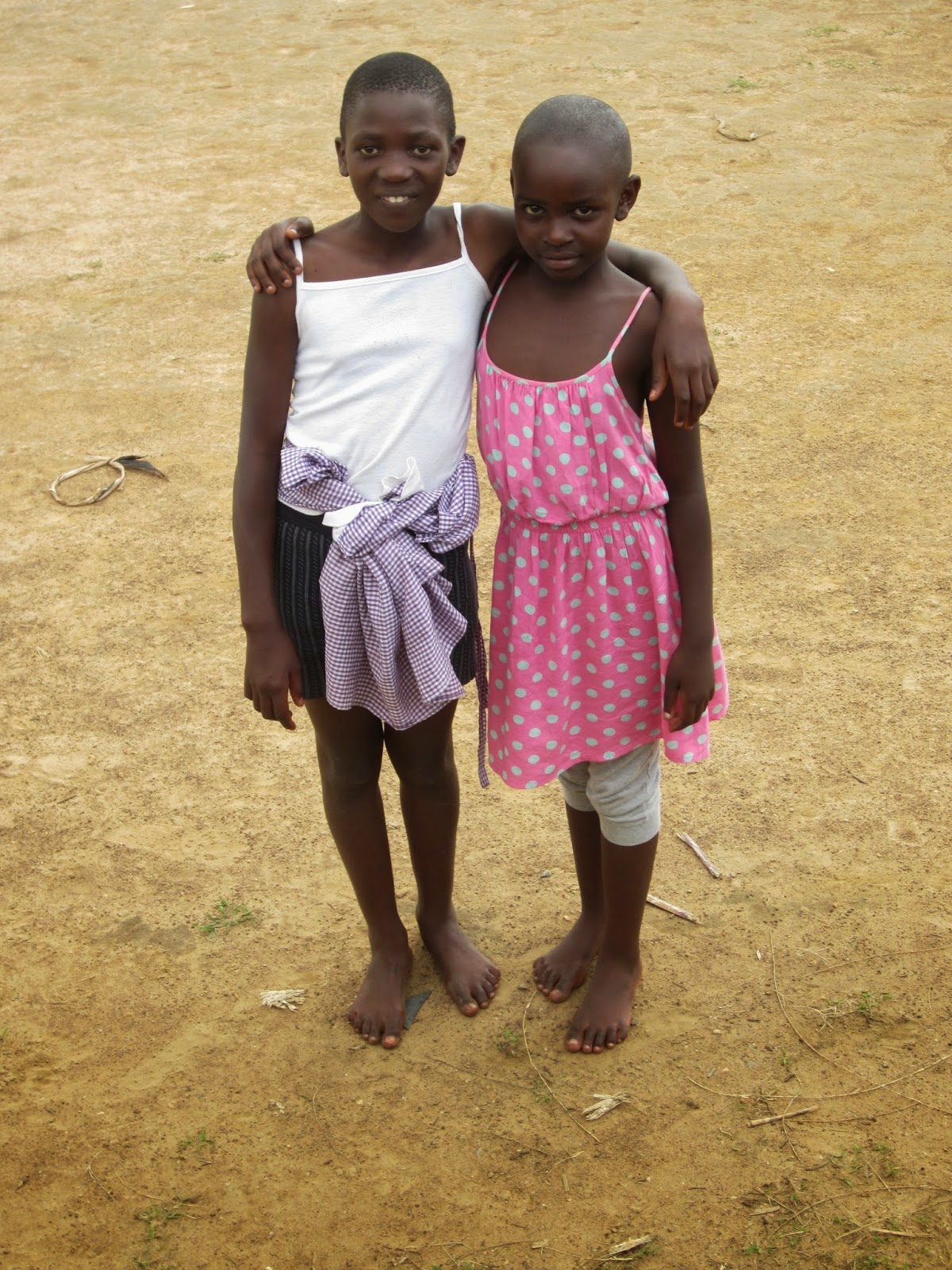
Two of my pupils, Peace and Sandrah.
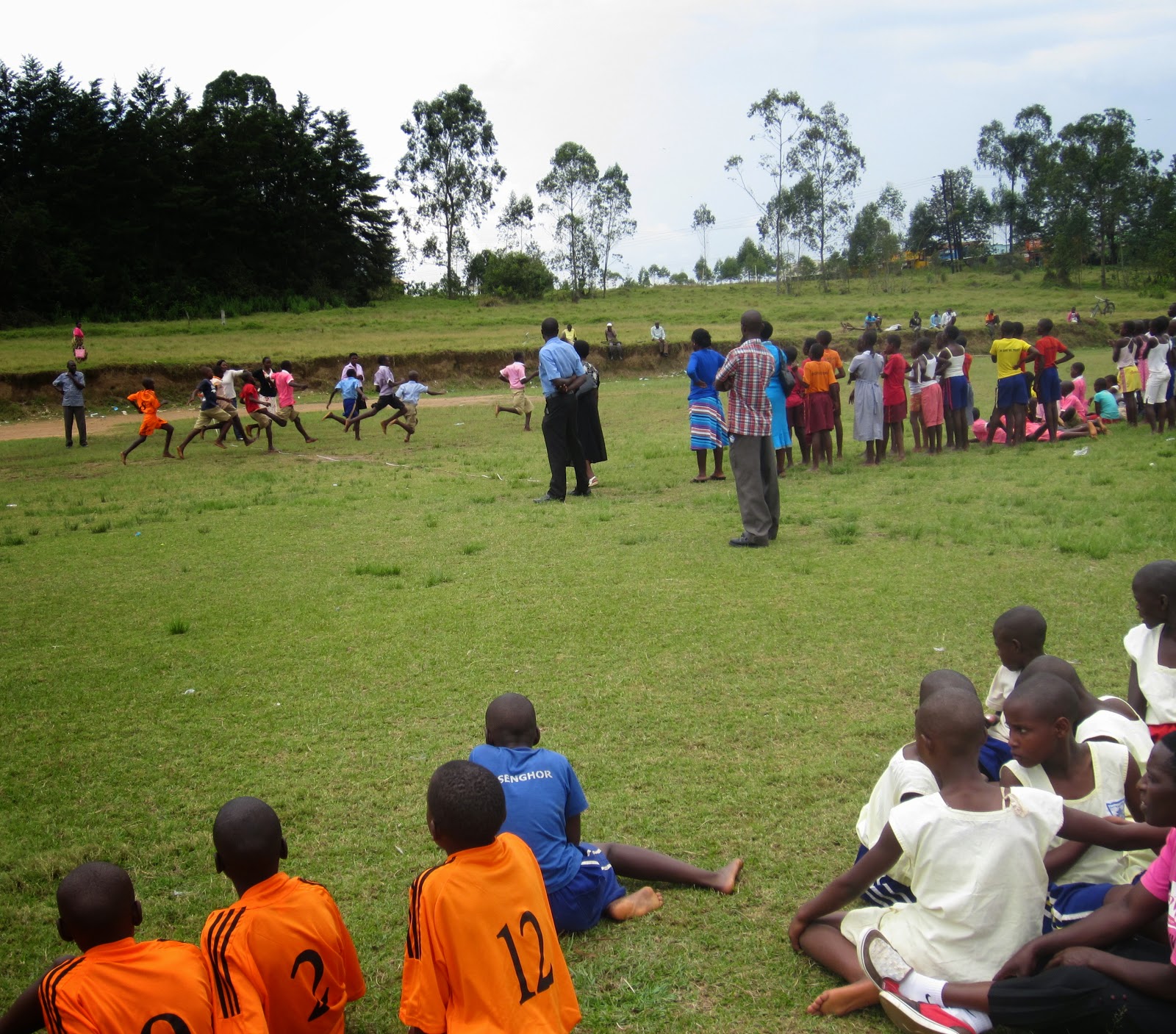
Some uniformed pupils from other schools watching their classmates compete.

Despite the outward differences, every pupil was extremely excited and wound up to compete. During the longer races, which were staked out with sharpened wooden sticks around the pitch to approximate a track, the pupils not competing ran wildly back and forth, yelling and screaming and cheering their classmates on. Of course, aside from having a day off of school and being allowed for once to burn off all of their youthful energy, a lot of this probably had to do with the fact that every teacher was feeding their pupils a steady stream of glucose from large cans. When Gatorade’s not available, piling glucose into eager hands is the next best thing to keep your team's energy up!


Going all out - I can't remember the last time I saw someone give absolutely 100% of what they have.

Glucose for everybody!

When it got to the hurdle portion of the day, the purpose of the mysterious foam pieces, jerry cans, and sticks that Kris and I had seen in the library became clear. The foam pieces assembled to become kid-sized hurdles and, since there weren't enough, hurdles were also made by sliding a stick between the handles of two jerry cans. The athleticism of the kids was unbelievable, especially since most of them didn't have the chance to train for any of these events! Living a life outside as a child certainly has its benefits.


Towards the end of the day, we moved to a different pitch, albeit still one without shade from the relentless sun. Many of my pupils from the school who weren’t participating had shown up once school had let out for the day. In the oppressive heat, they were practically salivating over the icees one entrepreneurial woman was selling out of a cooler under the shade of an umbrella. Two of my bolder girls, Gift and Lucky, came up to Kris and me to ask for money to buy icees. While Kris and I debated, all of my 40 pupils present slowly crept up around us, waiting for our decision. Even though we have been actively fighting against the image of Americans who come in and throw money everywhere, I was indecisive because it felt like such a universal moment to me, being a teacher at a sporting event, supporting and cheering on my pupils. Kris and I decided that since we felt like a part of the community now, and it was something we would do in the U.S. without thinking, that we would go ahead. Thrusting a 5,000 shilling note into a prefect’s hand, I instructed him to bring me back the change. The herd of kids sprinted away, swarming the poor saleswoman, and trickled back one by one to sit down next to us again, slurping away on their frozen treats. The prefect, Dan, carefully monitored the purchases to ensure that each child received only one icee. Once everyone had gotten their share, he brought the change back to me. I stared at the crumpled bills still remaining while my pupils chattered happily around me. The price to buy 40 children icees? About 75 cents.

Lined up on the raised edge of the pitch, our feet dangling, Kris, the kids, and I watched the next event. The javelin, shot put, and discus throw were clearly alien to most of the pupils. Patiently waiting in line for their turn, their names written on a piece of paper attached to a twig that would mark their farthest shot, they listened to their teachers explain how to use these colonial-area throwbacks. Laughter abounded as each kid tried as hard as they could to chuck each of them as far as possible.


The final events of the day were all about jumping. First up was a long jump in which the participants had to carefully follow a prescribed routine of steps and hops while approaching the sand pit. 

Still maintaining proper feminine decorum in a school uniform dress.


Then, the teachers set up a high jump and explained to the pupils how to properly jump and land. Seeing how the landing area was just a small pile of old hay, the kids were understandably reluctant to begin at first. To Kris and I, the setup looked less like something to be encouraged and more like something an American parent would freak out about finding their kids playing with in the backyard. However, Uganda is certainly not the land of helicopter parents! 


After a few repetitions of the teachers running up to the rope and demonstrating how to leap over it (without actually doing it themselves), one brave pupil stepped up. Once she successfully did not die, the rest of the children lined up eagerly and once again proved that they were up to any task – and that American parents are, on the majority, vastly overprotective.

That's my pupil, kicking butt in her pink dress!


It was a really fun, very different day and an experience both Kris and I were so glad to have shared with my pupils. Unfortunately, the experience also ended up burning the absentminded two of us to a crisp. (Sorry Moms!) In the staff room the next day, my teachers were shocked by my striped appearance, and even more appalled when I told them that my burns were from the sun. “The sun did this to you?!? You are so fragile!” 

It's already starting to tan here, but I was quite stripey for a few days!

When I actually think about the fact that the life-giving rays of the sun can cause me severe physical harm, it really is ridiculous. Right up there with invading aliens who are killed by water. Once my counterpart got over her shock, however, for the rest of the day she delighted in showing everyone how my red, burnt skin would turn white when she pressed down on it. Good times. 

Despite the resulting discoloration, this relaxed, fun, unique day made something in me click. Uganda is finally starting to feel like a home. Whether it’s rooting on my pupils, laughing with my teachers, being welcomed back by my neighbors after a long time away, or feeling the warm grass on my bare feet as I run a jerry can outside for the milkman to fill, I am starting to find a bit of that elusive sense of comfort.


"Home isn't a fixed place; it's an earned idea, a belonging, a growing sense of knowing where you are in relation to everyone else, and it's the knowledge of the truth that everything exists in relationship."
- South African immigrant to the U.S.

Friday, April 10, 2015

To Market, To Market


Wednesdays are market days at our trading center. During the rest of the week, it’s hard to find most fruits or vegetables in town unless you are growing them in your own compound. But on Wednesday, the traveling market comes to us and sets up in a big field behind the dukas (small local stores). Vendors set up early, wheeling in their bicycles laden with pineapple or matooke. Women lay their tarps out on the ground and string more up above, piling their fruits and vegetables into perfect pyramids on the ground. The fish-mongers position their products, whole, dried fish which have spent hours strung on the front of a matatu to get there. Hawkers can be seen in the early morning trudging along the roads to the market, carrying immense wooden boards filled with sunglasses, watches, hair nets, toys, hats, and more. The smells of popcorn, fried banana cakes, and samosas fill the air, ready to be snatched up by children on break from school later in the day. Those selling clothing drive wooden poles into the ground, making racks with banana-fiber fastenings and carefully hanging their freshly-washed and pressed trousers, skirts, dresses, and shirts. Men sort hundreds of shoes in enormous piles and the iron-mongers carefully arrange pots, pans, and knives in an attractive display under their newly-erected tarpaulin covers. Tailors bring their old-school sewing machines onto the field and set up near the clothes, ready to alter that oversized H&M or Abercrombie dress or top someone just picked out of the piles for sale. Young boys similarly set up next to the home goods section with their jury-rigged stationary bicycles, the chain attached to a grinding stone, offering to use pedal power to sharpen your newly-purchased knife.


I generally head to the market to meet up with Kris after school on Wednesdays. I take the shortcut through the fields and behind the stores to emerge into the festivity that is market day. A constant stream of people can be seen on the roads all day, walking to our trading center to buy food, meet with friends, swap stories, drink beer, and make deals. Dodging low-hanging tarps, we walk around to see which village woman has brought the best produce that week. Fruits and vegetables are sold in pyramids five or ten deep that sell for 1,000 or 2,000 shillings (about 30 to 50 cents). The women pack each pyramid into a small clear bag, twisting the tiny amount of plastic left at the top into a knot with their deft hands. They offer to place the bag in your woven basket and your money immediately disappears somewhere in their aprons. Many times we will often also get “bonus,” an extra tomato or potato thrown in from a random pile apart from the pyramids, for greeting and thanking them in Runyankore – it almost never fails to make people laugh appreciatively, as it is usually the first time they’ve ever heard a foreigner speaking their language. We are also often parroted in well-meaning hilarity among people around us that we aren’t even talking to.

Kris: Wassibota, nyabo! Good afternoon, ma’am.
Men hawking shawls: Haha, wassibota nyabo! Naamanya! Haha, good afternoon ma’am! He knows!
Kris: Ninyenda emondi, enkumi ibiri. I want Irish potatoes, for two thousand shillings.
Men: Emondi! Naayenda! Naayenda emondi, hahaha. Potatoes! He wants! He wants potatoes, hahaha.

Kris and I grin good-naturedly (most of the time) and wave to the hawkers, moving on. Market day is very social and we often see people we know from surrounding villages. Running into Maude, she bargains with her friend selling pineapples to get us 100 shilling discount (about 3 cents). We go with her to price beans she is planning to use in the rows of her new banana plantation. She decides that the price per cup is too expensive and we walk with her back to her bicycle – she is one of the only women I have ever seen around here who rides. On our way out of the market, we browse through the clothing section and I find a pair of jeans with a broken zipper that I really like. I bring my purchase to the woman lying on the ground in front of the clothes and begin to haggle. While food has more standard prices, when it comes to other goods, haggling is expected – and enjoyed! She starts off by quoting me 7,000 shillings. After a lot of dramatic gesturing at the garment, “Eh!” noises, and other sounds of outrage and protest made by both of us, I get her down to 4,000, a little over a dollar. Knowing Runyankore comes in very handy when haggling for a fair price!

One of our market day hauls, complete with new pants!

Now it’s time to walk about the trading center to get our daily supplies. First we go visit Donna to get our milk. She greets us happily and ladles milk into a small plastic bag for us which we carefully place on top of our other purchases. 

No refrigeration here - just a vat of milk straight from the cow. Before drinking it, we have to make sure to boil it.


Across the street we buy our bananas from the women we have affectionately dubbed “The Banana Ladies,” who are always ready to chat and quiz us in local language. 

The Banana Ladies meeting my mom!

I bought my skirt in the U.S., Constance bought hers here, and we two people who live halfway across the world from each other randomly wore them the same day in the same tiny village.

Finally we head back up the road and make Robert’s duka our last stop. Robert and his family run a small general store and have made us feel welcome since we first moved here. There we purchase our bread, flour, sugar, and eggs. Looking into my purse, I realize I don’t have quite enough money and Robert waves me off, telling me to just pay the difference to whoever is there the next time we stop by. 

Robert! This is a fairly-typical looking duka, packed full of everyday needs with a little bit of randomness thrown in.

Entrance to a duka in the trading center where we bought our charcoal stove. Yes, we are the Pied Pipers of Uganda.

Kris and I greet the gatekeeper as we reenter the college grounds and lug our bags up the path to our house, eagerly anticipating the fresh marinara sauce we will make that night on our gas stovetop.

Our path home. Food may be limited in variety here but what they have is plentiful! Like falling-on-your-head plentiful. (This almost happened to me with an avocado once.)

If we want bread that isn’t sweet (unfortunately the only kind found in most places here) to go with that pasta, however, we need to plan ahead. When we need food and market day is too far away, or if we need something particularly “exotic,” we make the three-hour round trip into Mbarara, the closest town. We ask to be dropped off at the Post Office – the great thing about public transportation here is that it will stop anywhere you want – and walk to the daily market, a permanent setup in the heart of the town. At its entrance are two heavy metal gates, open during the day. Wheelbarrow men sit resting by the entrance, perched on top of their overturned wooden vehicles, waiting to be hired. As you enter, the light turns faintly blue from the overhanging tarps and a wave of sound rolls over you of people greeting, bargaining, shelling, butchering. The arrangement at the daily market is more permanent. There are long rows of wooden stalls with small doors built in below the counters that the vendors duck back and forth under, alternating between sitting in their tri-legged wooden stools and fetching items in the back for their customers. Areas have loose designations – a large section for vegetables and traditional products in the front, a long, narrow, aisle along the back for heaping bags of fruit, a wide shelter containing carcasses of cows and goats hanging from the ceiling with shiny brass scales in front of each, and a winding maze of smaller stalls with farming tools, foreign clothes, and vibrant kitenge fabric. In the main section, the produce is polished and piled in perfect formations. Towering heaps of tomatoes, Irish potatoes, and beans are balanced perfectly in their woven baskets and the selection threatens to overflow into the aisles. 


 We head to our favorite vendor for our regular vegetables - tomatoes, Irish peppers, carrots, onions, and green peppers. Deus has a small section in the middle of the aisle, his neighbors’ produce almost pinning him in as he relaxes in front of the counter listening to the radio. We are always greeted with a big smile, a warm welcome, and usually “bonus.” We then hit up the “exotic food” stall for things like cauliflower, zucchini, fresh cilantro, and, if we’re lucky, a head of lettuce. If there are any household items we need, we’ll head to the craft section and bargain for a new basket or woven rug before continuing our errands.

Haggling for another vegetable basket - after we are quizzed to make sure we know its use.

We then weave in and out of bodas, taxis, minibuses and private vehicles to cross the street to the tailors’ section. Multiple alleyways are filled with men and women working on push-pedal Singer sewing machines outside their shops. Every surface is strewn with beautiful, colorful kitenge. Tables for ironing are set up in the alleys as well; people carefully press the cleanest clothes I’ve ever seen with their charcoal irons, occasionally wetting the fabric with water from a cleaned-out plastic soda bottle with a hole in its cap. We get measured or pick up our new clothes from Nick, our favorite tailor, and sometimes get to enjoy watching women try on their glittering bridesmaid or giveaway dresses. Here, getting clothes custom-made is extremely cheap compared to the U.S., but tailors are having a harder time getting business because of the influx of clothes donated from abroad that are being sold at a much cheaper price. But being a tailor is still a good profession here, and I am constantly impressed by the incredible quality of clothes I see being made under an umbrella in the sweltering heat of an alleyway.


Our last stop is usually Nakumatt, an actual grocery store in Mbarara that is extremely popular with foreigners. We step into the air-conditioned entrance and wander around to pick up the items we can’t find anywhere else – real butter, baguettes, brown bread (which they call “salty bread” here), cheese, certain kinds of beer (yeah, OK, that’s just for me), and herbs and spices. Then it’s back to the Post Office to catch a matatu back to our trading center. Sitting six to a row, my big backpack on my lap, my right side smushed up against a strange man and my left arm cradling a baby being nursed by her mother, I wiggle my right hand free and snack on my street popcorn T-Rex style. Like so many things in Uganda, shopping is time-consuming, loud, noisy, hectic, and oftentimes frustrating, but it’s always an adventure and in the end, completing it is a triumph in and of itself.

When you are discontent, you always want more, more, more. Your desire can never be satisfied. But when you practice contentment, you can say to yourself, "Oh yes - I already have everything that I really need."
- Dalai Lama

Friday, August 15, 2014

Maude's Story


Maude showed up at our door that Sunday to take us to her home, her brother beside her on a bicycle, bearing a bunch of green bananas and a bright blue basin full of jackfruit and avocados. She was there to bring us to her home and show us her new business, an apiary she started two years ago.

We walked along the road towards her village, Kris carrying the empty basin she had brought us food in. We passed by two women digging in the fields, just back from church in their best kitenge. Maude went to greet them and came back with the basin, now full of Ugandan sweet potatoes, balanced on her head. Laughing at Kris’s offer to keep carrying the basin, his ability to carry it while full of potatoes clearly hilarious, Maude led us onward, branching at a dirt path leading deeper into the hills. While we walked, Maude asked us what Americans know about Uganda, and I struggled to find a way to tell her that the only things most Americans associate with Uganda are Idi Amin, AIDS, and the nickname of the Pearl of Africa…if that.

As we paused on top of one of the lush green hills, a small girl approached us. Maude explained that Shivan was actually her niece, but Maude has been taking care of her since her mother died. She handed over the apparently too-heavy-for-Kris basin full of potatoes to the eight-year-old with instructions to run ahead and begin the preparation for lunch. As Shivan balanced the basin on her head and nimbly moved ahead, Kris and I took a moment to exchange a glance and a laugh at Ugandans’ constant low estimation of our physical abilities.

We stopped one more time as Maude pointed out her village. It is small, with perhaps a couple dozen homes scattered across the rolling land and a one-building trading center where the villagers can buy soap and other necessities. As we climbed the last hill to Maude’s house, we paused at the top and she pointed out the lines of the property her family has held for generations, spreading out over banana plantations and sprawling fields.

We entered Maude’s compound, a cleanly swept dirt area consisting of three different buildings. The first contains a sitting room and several bedrooms, while the second contains a storage room and more bedrooms for the variety of children that live there, beds piled high with foam mattresses and the ubiquitous Ugandan blankets. The last is a kitchen separated into a cooking area and an eating area with a dirt floor covered in grass. Maude pointed out the nesting chickens in the corners of the kitchen; this is where they lay their eggs when they are ready. She then brought us around the corner and showed us the neighboring mud and wood constructions housing hundreds of goats and chickens.

After the tour, Maude introduced us to her aging mother, various nieces and nephews, and her grandnephew. Kris and I settled into two wooden chairs brought outside for us, playing peek-a-boo with the grandnephew. We were presented with about a dozen bananas and told that we were expected to finish them while Maude bustled around, preparing for lunch, slaughtering a chicken, shooing the dog out of the kitchen, and instructing her nieces. Once she was satisfied that the meal she had begun over the open wood fires in her kitchen could be continued by her family without her direct supervision, she took us to see her apiary.

Maude began her apiary as an income-generating activity two years ago with only the help of a local boy whom she is able to pay, as she says, “not nearly enough.” With almost no knowledge of beekeeping, she managed to produce almost 100 liters of honey in her first year using traditional methods such as hand-held smokers and hive baskets she wove herself. She admitted to us that she is still learning as she goes; her first year, she threw away all of the empty comb, having no idea she could sell it at a profit to candle makers. This year, she is expanding her twenty hives to fifty and building more modern, “but still not very modern”, frame hives made of timber, nails, and screening.

As we inspected the woven hives plastered in clay and covered with aluminum sheeting, it began to rain. Maude brought us back to the kitchen to check on lunch and we were promptly ousted by her mother, who was outraged at the idea of making visitors eat in the kitchen. Maude showed us to the sitting room and Shivan brought the three of us our lunch of matooke, boiled sweet potatoes, and the freshly-slaughtered chicken with a Ugandan sauce. When we finished, we relaxed with some homemade lemongrass tea and, of course, honey, listening to the sound of the rain beating down on the tin roof.

Maude excused herself for a moment and returned with a pile of yellowed photographs wrapped in a fading campaign poster. She carefully spread them out on her lap and began to tell us about her life.

Maude was born the youngest of ten children. Her parents were farmers, as their parents before them and their parents before them. As the youngest, however, Maude had more opportunity as her older siblings grew up and also began to earn money. She graduated secondary school and went to business school in Kampala, the capital city. Her life early on, as she put it while showing us a picture of her in a Banyankore-style gown, was easy. “I could have chicken and fish whenever I wanted!” she remarked, laughing and patting her now much-smaller stomach.

She stayed in Kampala for 19 years, working various office jobs. However, during her time there, tragedy began to strike her family. Maude explained that her father had been a polygamist who died during her time in Kampala, leaving behind three different families in as many villages. She then pulled out a photograph of a solemn-looking man, her brother, explaining that he had been killed during a robbery. Two more of her siblings, a carpenter relaxing casually on a newly-made cabinet, his leg thrown over the side, and a beautiful woman laughing happily atop a truck, passed away in the following years. At that time in her life, Maude began to receive phone calls from her surviving brothers and sisters, exhorting her to return to the farm to take care of the plantation and their mother, only in her fifties but crippled by diabetes. Maude told us that she resisted at first – give up her office life in the capital she had worked so long for to move back to the village?

Maude then pulled out a picture of her and one of her sisters sitting on a hospital bed. Between them was a woman, leaning forward towards the camera, clearly suffering but surrounded by love. Maude told us that was her first sister to die of AIDS. Years later, AIDS took another, leaving her family of ten children with only five. The sisters left behind children of their own which their mother took in. However, their mother was having trouble supporting the orphans, and Maude finally decided to give up her life in Kampala and return home to the village.

Maude took charge of the farm, raising the hundreds of chickens and goats and several dairy cattle along with taking care of the banana plantation. Still unwed, which is unheard of here in Uganda, she is looking after the children her siblings left behind as if they were her own, paying for their school fees and proudly boasting to us about the ones first in their classes. Her mother is relieved to have her home, but, now in her sixties, is losing her battle with diabetes and has sunk into a depression after the decimation of half the family. Maude is ever-optimistic, however, and plans on continuing to expand the apiary and using the income to relieve some of the hardships poverty has forced upon her family. She is confident that her lack of beekeeping experience will not hold her back; she will leverage the business education she gained in Kampala along with the knowledge and traditions that she has learned in the village to make it work.

“I have suffered,” Maude told us, “but I am bold.”

A sample batch Maude brought out for us.

She wraps the netting around a pot to allow the honey to drain out of the combs.You can also see the smoker she uses on the bees.


Giving us a taste of honeycomb! Apparently you are not supposed to swallow the comb itself...whoops.

Maude's hopeful expression was rewarded after Kris declared it the best honey he's ever tasted!

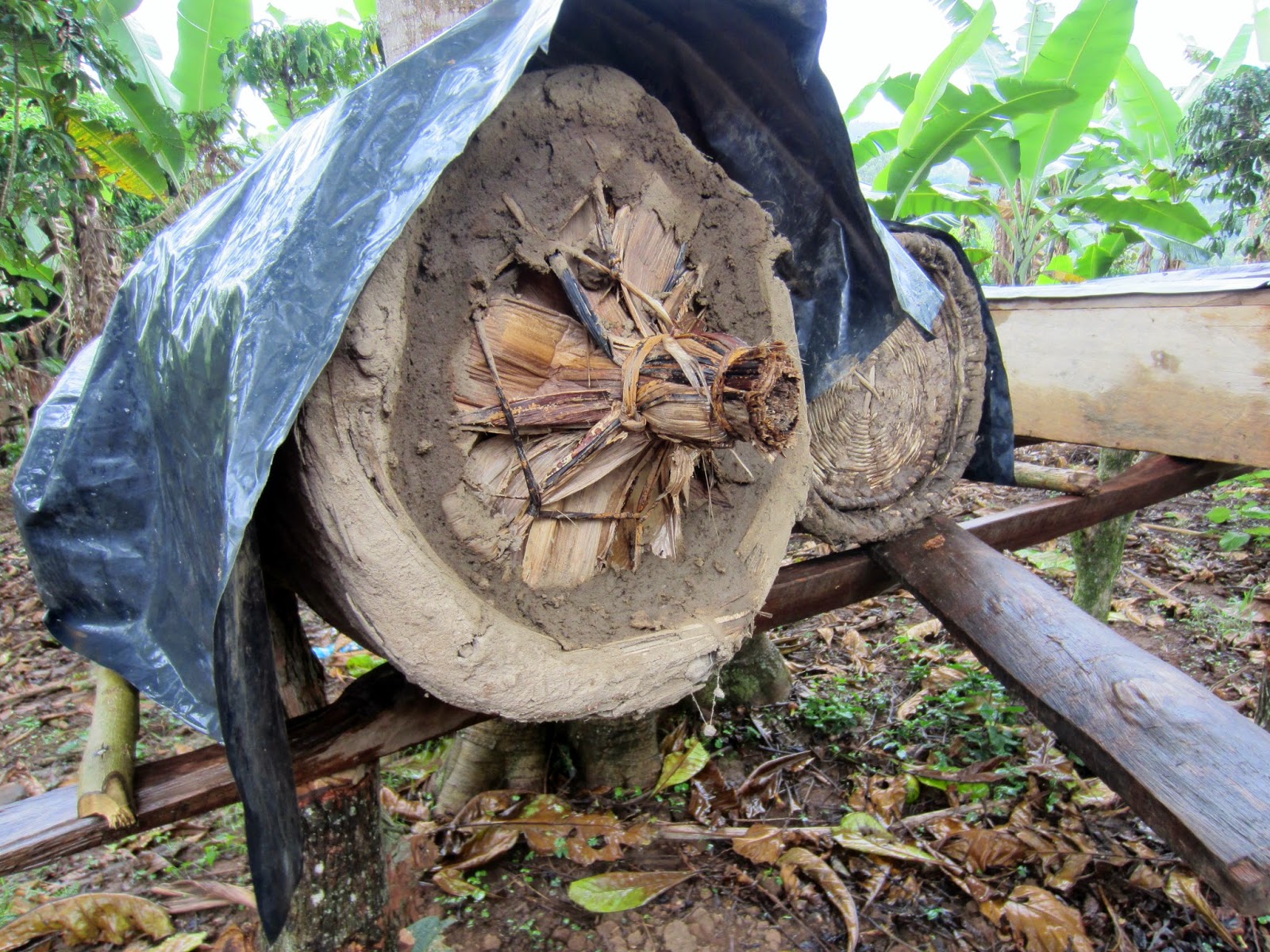
One of the traditional hives that Maude made herself, woven from papyrus reeds and covered in mud. The aluminum siding is used the cover the hive during rain and keep it warm.

This hive has been plastered with mud to close it in preparation for the bee's honey production.

The more traditional frame hives Maude has started to build.


Bees starting their hive!

She drills holes in the back to allow the bees to fly in and out.

Matching hats!

All of the food that Maude left us with, including a long piece of sugarcane. Which you are also not supposed to swallow.

As we were leaving, Maude was pouring her last gift for us; a jar of her very own honey. As she presented it to us, letting the light filter through the now-golden jar, she proudly said, “One day, you will see this on a supermarket shelf in Kampala.” Then she slipped back into her mismatched, mud-covered sandals, ducked under the dripping clothes hanging out to dry, and took the bag of sweet potatoes from my hands to guide us home, her mother’s chiding voice floating in the air behind her, reminding her to always carry a guest’s things.

When we focus on ourselves, our world contracts as our problems and preoccupations loom large. But when we focus on others, our world expands. Our own problems drift to the periphery of the mind and so seem smaller, and we increase our capacity for connection – or compassionate action.
-Daniel Goleman