Showing posts with label Peace Corps. Show all posts

Thursday, October 8, 2015

Uganda Spelling Bee

“If you have sorted out the world in one language, it becomes much easier to sort it out in a second language.” – Pauline Gibbons

Language and literacy are fascinating. What a wealth of knowledge, history, and culture that lives within just one tongue. What incredible universes the written word has opened up to us. They are glimpses into the human mind, snatches of the magic and power we have inside of ourselves. They are the cornerstones of the world we have built.

In college, I was introduced to a profession where my passion for language and literacy was combined – teaching English as a Second Language. The English language is an intricate puzzle that, when unlocked, can open to life-changing opportunities and insights, and few things bring me greater joy than to work on that puzzle with others. But as much as I love English, as much as I delight in sharing in it and despairing of it with others, I also realize how much the world would lose if every thought originated only in English.

English is not meant to be a replacement, a bulldozer razing indigenous languages and cultures; instead, it is meant to be used as a tool, a tool to make connections and exchange knowledge. This is not always the message that is communicated and, unfortunately, centuries of colonialism have wrongly placed it as oftentimes higher, more valuable, more desirable than one’s own mother tongue.

This colonial hangover is present even today in Uganda. Despite a switch to education solely in local language from Primary 1 to Primary 3, with Primary 4 being the “transition year” to instruction in English from Primary 5 to Primary 7, there is no denying that English is the language of opportunity here; whether someone is looking for a professional job abroad or in country, being able to speak English is a must. However, this attitude has led to a devaluation of native languages and a misunderstanding of how best to achieve fluency in a second language. Such unfortunate devaluation can be seen in the following words of one Ugandan:

“Children … should learn a language which helps them in the future. Not put them in brackets of a second community.”

Rural parents and community members often believe that such a language policy, attempting to ensure that a child learns in their native language in at least the first three grades, has been imposed for political reasons; they are frustrated because they want their children to master the language of wider communication, English, as quickly as possible. Some even mistakenly think that African languages are not able to deal with scientific and technical concepts. To them, a local language policy seems like a step backward to the past, not forward to the future. This is detrimental because, as any Peace Corps Volunteer knows, if a community does not embrace an idea, it will not happen.

But many in the Ugandan community, especially the rural community, are not embracing this step because they have not been informed of the pedagogical advantages afforded their children when they are they are instructed in their first language before moving on to being educated in English. It can seem contradictory, but the more time children spend learning in local language, the better they will perform academically and the more fluent they will become in their second language. For example, first language speakers of Afrikaans in South Africa, in places where English is taught only as a subject for one lesson per day, have been shown to successfully achieve high levels of bilingual proficiency in both Afrikaans and English – not being instructed in English was in no way detrimental.

If parents want their children to learn the language of wider communication, in this case English, it will take these pupils six to eight years of learning English before it can be successfully used as the medium of instruction for academic concepts. If this process is hurried, the pupil will learn neither the new language nor academic content well enough. Imagine trying to learn physics or study classic French novels with only your three years of high school French!

When it comes down to it, if a pupil is not literate in their first language, it is incredibly difficult for them to become literate in a second language. Literacy, in both first and second languages, is immensely important to individuals and to countries as a whole. It has been found, using panel data for forty-four African countries, that literacy was among the variables with a positive effect on GDP per capita growth. Literacy skills are fundamental to informed decision-making, critical reflection, personal empowerment, creativity, and participation in political, social, and cultural spheres. Furthermore, while it’s hard to separate the benefits of literacy from education, schooling, and knowledge overall, it has been shown that literacy among women improves livelihoods and leads to better child and maternal health in addition to empowering those women to gain access to and challenge male domains. The Reading Agency has even shown that reading for enjoyment can increase empathy, improve relationships, reduce symptoms of depression and raise wellbeing!

However, first-language literacy and literacy in general face particular challenges in Uganda. There are 63 main languages spoken, none with a large enough majority for one to be selected as the national language. 52% of Uganda’s 36 million people are children below the age of 15, and 71% are not finishing primary school in time. This is caused by, among other reasons, low competence, low literacy rates, and lack of interest. In fact, Uganda is ranked lowest in the region in literacy according to a 2012 Uwezo report.

These are problems that many Ugandans are well aware of and something that two amazing Ugandans in particular decided to do something about. Peter Mugogo and Aaron Kirunda, the founders of their own business based in Kampala, decided that establishing their own microfinance company was not giving back enough to their community. They passionately believe that Uganda’s future belongs to that 52% below 15, and they realized that the literacy rate needed to be improved, academic achievement celebrated, and key life skills developed in these children in order to ensure that they were motivated to stay in school and ensure a bright future for Uganda. So, three years ago, they started Enjuba Spelling Bee, an English spelling competition for teams of three in Primary 4 through Primary 7.

Aaron and Peter

One year ago, Peace Corps Volunteers Loren Evans and Jason Economou made their own realizations. For the literacy rate both in pupils’ local languages and in English to improve, communities had to embrace the government’s local language education policy for Primary 1 to Primary 3 and possibly even a future extension of it to Primary 5 or Primary 7. This meant boosting the status of indigenous languages, developing the orthography of languages if necessary, providing teachers with professional development, and increasing the amount of available written materials in local languages. Thus, the My Language Spelling Bee, a local language competition for Primary 3 pupils which I wrote about last year, was born. 

This year, as one of the National Co-Directors, I have had the incredible privilege of being able to witness the birth of what I and my Co-Director, Ben Ferraro, truly believe is a model Peace Corps partnership with dedicated, hardworking, and passionate Ugandans. 

My Co-Director, Ben, working on the My Language Spelling Bee in Arua district.

Enjuba Spelling Bee and My Language Spelling Bee, along with the Ministry of Education and Sports, have joined together to create Uganda Spelling Bee, offering in-service teacher trainings, a P3 local language spelling competition, and a P4 – P7 English spelling competition across Uganda. We believe that this national initiative, besides just being incredibly fun, will help primary school pupils and their school communities understand the importance of both first and second language literacy. This awareness and these competitions will, hopefully, in turn, increase literacy rates by training teachers in learner-centered literacy instructional techniques and by helping pupils learn key life skills, ignite their curiosity, become inspired to stay in school longer, and develop pride in their mother tongue as well as improved competences in English. It’s a lot to put on one project, but if anyone can do it, Peter, Aaron, and their team of highly-educated, caring Ugandan volunteers can do it. 

Michael and Juliet, two more volunteers from Enjuba Spelling Bee


This month has been the beginning of the culmination of a year’s work for Uganda Spelling Bee. Recently, the Runyankore/Rukiga My Language Spelling Bee finals and English Spelling Bee semi-finals were held at the Primary Teacher’s College where Kris and I live. The response, excitement, and anticipation of this year’s events by the community were overwhelming. Our reach was much greater than last year due to the new partnership and due to the fact that ownership of this project has been almost entirely taken on by wonderful community partners in Bushenyi district, partners such as Mugisha Laban, who have embraced Uganda Spelling Bee and taken it far past where I ever thought it could go. In-service teacher trainings revolving around spelling bee practices and learner-centered teaching techniques were held during the second school term and school, district, and regional-level competitions, run almost entirely by Ugandans, proceeded from there. The Runyankore/Rukiga My Language Spelling Bee alone reached over 10,000 pupils, 275 teachers, and 190 schools in the Southwest overall – and that’s just one of the six language regions Uganda Spelling Bee is currently operating in.

The day of the competition was filled with music, word lists, and excited pupils practicing under the shade of nearby trees. 


Paul Benz, the Music Man!

Kris and Immaculate enjoying the entertainment.


The Deputy Principal of the college opened the event by speaking of the importance of local language literacy and the role it plays in achieving second language competence. He urged teachers to continue the learner-centered literacy practices they had learned and praised the event as a project that supported the celebration of academic excellence and that now belonged to the community itself.

The preliminaries for My Language Spelling Bee and the English Spelling Bee were held side by side, with brief musical interludes, before lunch.


The English Spelling Bee pupils were a bit shy and nervous at first, so the judges had the pupils take their spots and quiz their teachers!

This adorable 8-year-old pupil did a great job in the My Language Spelling Bee.

The MLSB judges conferring.


A small break before lunch.

The college students and scouts helped us serve.

Olivia, my P3 pupil.

After lunch, all attending watched the My Language Spelling Bee finals, with pupils spelling words like omuhingánzima and ekiteetéèyi, until only one child remained.


Then came the English Spelling Bee finals, with the primary school pupils impressing all of the adults present by tackling words such as endogenous, paradigm, and xenolith.


Everyone, of course, received certificates and the top three My Language Spelling Bee finishers received donated books, games, world maps, and academic supplies for themselves and their schools. 


Laban closing the ceremony.

The winning pupils from my school.

The Southwest Uganda Spelling Bee team! Minus Robert Hahn, that is.

Letting off a little steam after a long day.

The top three English Spelling Bee teams now move on to the National Championship in Uganda’s capital, Kampala, on October 17th - an exciting prize in and of itself for the public school children, especially since some have never been outside of their own district or ridden a bus before. It’s going to be an extremely exciting event, and I invite all of you to be a part of it by liking Uganda Spelling Bee on Facebook and Twitter. Please, follow along and give these amazing pupils your moral support on their big day!


References


Friday, August 21, 2015

"Getting Used"

“Eh, you will get used!” It’s a refrain I, and many Peace Corps Volunteers here, have heard time and time again from our Ugandan friends. Whether it’s the sun, the food, or the incredibly subtle facial expressions, we’ve all been waiting until we are “used.”

It’s almost two years in now, and I finally feel like I have (mostly) learned the rules, know how to play the game, and can finally tell when someone is saying yes with their eyebrows. I get what’s going on around me now, especially when it comes to public transportation, and it’s actually a really great feeling.

Last week, I hopped off of a matatu at the Mbarara bus park, ready to head to Kampala. There weren’t any buses from my preferred bus line, Global, around yet, so I headed to the waiting area. I wound my way into the group of wooden benches covered by a plastic tarp, stepping over bags and chickens trussed up for the journey. Pushing my way in to a seat in the middle, I waved my money in the air, just like everybody else, desperate for the ticket seller’s attention. It was a crazy day for travel – the bus park was jammed to the brim and people were paying full price for all the way to Kampala, even if they were planning on getting off halfway, just to get a seat. After I got my ticket, one of the last available for the next trip out, I left the seating area and stood over where I estimated the bus was going to arrive. The sun was beating down, my shoulders were aching from carrying my backpack, and there was a speaker blasting right behind me, but I was going to get a window seat, damn it.


After about a half hour of waiting, a Global conductor – one of the many men and women swarming around in yellow Global lab coats – signaled for everyone to form a line; the next bus was arriving. I dashed into the wave of people swarming for the point in front of the conductor’s hand. The line was starting not far from where I had guessed it would and I could practically feel the breeze on my face from the window, taste the roasted maize that I would buy out of it for my lunch. I held out my arms and continued to push forward, elbowing away people who were trying to dodge ahead of me and taking full advantage of the extra heft my backpack gave me. As the fervor died down and the queue settled in, I stood not far from the beginning of the line with my body pressed up against the woman in front of me and with the person behind me directly up against my bag. The line had become almost a singular entity with not a millimeter of space between anyone in it for, as we all knew, even the smallest amount of space in the line would be tantamount to an invitation for another person to try and squeeze in.

As I watched the Global bus unload its previous cargo and passengers and waited for it to move forward, I leaned on the strange woman in front of me with not a thought for my personal space and realized, with some surprise, that it all felt completely normal. In fact, sandwiched in my prized spot in line, I was actually calm and comfortable – and a little smug too.

Yeah, I’m “getting used.”

"Happiness comes from...some curious adjustment to life."
- Hugh Walpole, Sr.


Tuesday, July 21, 2015

Peace Corps Cribs: Uganda

Welcome to our home as married Peace Corps education volunteers in Uganda! This MTV-style Cribs video was filmed by our friend and fellow PCV, Matthew Dahlberg, with special guest appearances by more friends/fellow PCVs, Carmen and Amanda.


Saturday, July 11, 2015

The Amazing Race Comes to Bushenyi!

A new group of Health and Agriculture trainees arrived in Uganda two months ago. Like my Education cohort did, they completed their “Boot Camp” and have moved on to stay with host families for intensive language training. The Southwest group, about 9 volunteers in total who will be placed in the Runyankore/Rukiga language region, is staying in Bushenyi Town, not too far from me and Kris. They attend language classes in town six days a week and every Friday, Kris has arranged for them to compete in…The Amazing Race: Uganda! If you’re not familiar with The Amazing Race, it’s reality TV show where teams of two race around the world to complete various tasks in different countries. It also turns out to be a great concept to adapt for language learning.

Part of Peace Corps language training is known as “community experience." This involves the trainees being set free in the local area in which they are staying and told to use the language tasks that they have been learning. They are supposed to practice greeting, ordering food, haggling, finding transportation, and, of course, talking up the Peace Corps with whomever they can find. It sounds fairly simple but in reality, as any language teacher knows, that's a monumental assignment for a student, especially when they're an adult. The uncertainty, fear, and exhaustion of being in a new culture coupled with attending classes eight hours a day, six days a week means that most students are too reluctant, too nervous, or just plain too tired to take their own initiative to practice their new language in a real-world context. 

One way to combat this is to give learners more specific assignments to complete. Creating guidelines and a safe, predetermined space to practice mitigates a lot of the anxiety adult learners can feel. After all, when you’re speaking a brand new language to native speakers, you really do feel like a child again a lot of the time! Add this idea to the fact that, when you’re American, you will naturally turn these tasks into a competition, and The Amazing Race: Uganda is born. The prize? Homemade baked goods, of course, from a selection of the six I’m able to make here. There are few things a Peace Corps trainee dreams about more than food (sorry, friends and family – they still love you).

So, each week, Kris has been traveling around Bushenyi Town and speaking to our Ugandan friends, asking them to provide tasks and interact with the trainees in local language as part of the Amazing Race. In a fringe benefit that we weren't expecting, the locals have absolutely been loving it. It means a lot to them to see foreigners really making an effort to get to know who they are while caring so obviously about their language and their culture. Plus, it’s funny to see a bunch of Americans running around frantically, trying desperately to remember the word for bananas.


This week, the race came to our trading center and schools! Kris set up tasks around the area and I waited at my primary school while Kris “released” the teams five minutes apart in Bushenyi Town. They had to travel by public transportation to our trading center, complete four tasks and one detour, and then travel back again.


The first clue:
You have to haggle for almost everything here, including transport, so 10,000 shillings can go fast if you're not good at bargaining!

Second clue:
Those might have been our clothes that the trainees were washing...

Third clue:
Immaculate has actually seen the Amazing Race, so she was super excited!

After talking to Immaculate, the trainees were given a fourth clue directing them to my primary school. Upon arriving, they had to enter the Primary One or Primary Two classroom and be taught a song by the pupils and teacher. My headteacher and deputy headteacher were there to greet them when they arrived, bemusedly shaking hands and directing the sweaty Americans to the correct classroom block. 

Each class presented its own challenges and advantages. Hope, the P1 teacher, was very strict about pronunciation, but she had written down the song for the trainees and allowed them to sit in the back with the class. 


Rebecca, the P2 teacher, was less strict about pronunciation, but she wouldn't let the trainees write anything down and made them stand in front of the class to learn the words.


Such good sports!

It is a simple song that the teachers sing with the little ones when it's time to practice handwriting: 


Kampandiike gye
Kampandiike gye
Kampandiike kurungi
Ndyaba karaani!

Let me write well
Let me write well
Let me write so very well
I will be a secretary!

Its length didn't make it any less difficult to sing in front of a class, however! But with the promise of baked goods on the line, the trainees performed beautifully.

Receiving their next clue from the primary school secretary.

The last clue involved a trip to the banana stand clear at the other end of the trading center. The volunteers had to haggle the price down to a reasonable 2,000 shillings and hope that they had enough left out of their 10,000 shillings to make it back to Bushenyi Town!

The set aside items might also have been from our grocery list...

It all ended up in a sprint to the finish line between two of the four teams, with one victoriously claiming their prizes of no-bake cookies and coffee cake. Hopefully, however, everyone also left with a better understanding of how to navigate around Uganda, a greater proficiency in Runyankore, increased confidence, and some good, albeit ridiculous, memories. 

"That was fun, but it wasn't fun."
- JJ from the Amazing Race


Monday, July 6, 2015

When Help Is a Four-Letter Word

I’ve gotten into the habit of locking the door and drawing the curtains whenever I get home. In the recesses of my house, cut off from the world, I’ve begun to consider the vastly complex issue of a deceptively simple word – “help.” I never realized it before, but as a society, we attach so many intense labels to the word help. The truly astounding part is that which label we choose to use depends on the context of the word – if the help is being given or received. In general, if we think of help in terms of being given, it is almost sanctified. It is a virtue to aspire to, a holy, spiritual quality of someone good and pure and admirable. If we think of help in terms of it being received, that picture changes. We associate the word with a sense of pity instead; needing help is something almost shameful, an issue that we distance ourselves from with images of homeless vets in soup kitchens or barefoot children in Africa. But on either end of the word, the labels attached to help are toxic and untrue. We’ll always fall when we put ourselves on pedestals of self-righteousness and, if we attach judgment to receiving help, we’ll also, however unconsciously, attach judgment to giving it. Help needs to come from a place of empathy, not pity.

We need to be able to acknowledge our own dark places, our own imperfections, and allow others to see them - we need to be able to receive help in order to give it. This is the journey that I’m on now. When you don’t want to think of yourself as the receiver, it’s so easy to shut yourself off from everyone else trying to help – hit silent when the phone rings, neglect your inbox, put in your headphones when someone’s knocking at the door.  But I have started to realize that when I close my door to others, when I don’t let them in, I can’t get out either. That closed door is not a one-way barrier to help. One of the most important things I’m learning here is how to keep my door open, to ask for help, however small, without shaming myself for getting it or telling myself that next time I’ll be able to get through it alone. Because I’m not alone. We’re not alone. No one is meant to make it through this world by themselves. Not reaching out to your family, your friends, your community, or health care professionals doesn’t make you strong, doesn’t make you tough, and certainly doesn’t make you better. In fact, it almost makes you stupid, and it does make it harder for you to reach out to others in an effective manner. I tried to make my life about helping without even realizing that I shrank from applying that word to myself as a receiver – and I don’t think I’m the only one. In these two years of Peace Corps, I never thought one of the most important things I’d learn in trying to help was how to ask for it and accept it while still feeling strong, still feeling enough, still being who I wanted to be. In order to truly be able to help, I now know that I have to learn how to be helped.

We must relabel “help” as normal, not something that is only required in extreme situations of poverty, natural disaster, or disease but rather something that everyone is able to give and get constantly. In fact, we can’t get through life without doing both. When we lock our door to others trying to get in, when we refuse to receive help, it traps us as well, making it so much more difficult when we want to give help to see who is on the other side and what they really need. It makes us vulnerable to keep that door open, to allow people to see inside, but it also frees us to help and be helped. If we want to really, truly help, we have to stop letting help define us, in one way or the other, and instead stand in our open doorways, exposed but present.


"If we’re going to find our way back to each other, vulnerability is going to be that path. And I know it’s seductive to stand outside the arena and think, I’m going to go in there and kick some ass when I’m bulletproof and when I’m perfect. And that is seductive. But the truth is that never happens. And even if you got as perfect as you could and as bulletproof as you could possibly muster when you got in there, that’s not what we want to see. We want you to go in. We want to be with you and across from you. And we just want, for ourselves and the people we care about and the people we work with, to dare greatly."
- Brené Brown


Friday, May 22, 2015

Fun and Games, Village Style

Practically from the moment they can walk, village kids begin helping their family out,
fetching water, tending goats and cattle, and taking care of younger siblings. Their responsibilities are a huge part of their lives – but of course, there’s always time to play. Whether watching their family’s herd, looking after their little sister, or hanging with friends during break time at school, there are games to be invented. While recreation for children in the more urbanized parts of Uganda bears a resemblance to American children’s toys and games, the “make it work” spirit of Uganda is very much alive in its rural children. Wherever they are, my pupils are prepared to augment their imaginations with cars made of sticks, cardboard, and bottle caps and to make sports possible with jumpropes made out of twisted banana fiber and soccer balls made out of plastic bags. These kids are resourceful!

One of the soccer balls (footballs), made out of plastic bags and secured with twisted and knotted banana leaf fiber.

During break time at my school there is no official supervision by adults. Instead the pupils self-organize games and competitions. The activities are somewhat monitored by the prefects but for the most part, their lifestyle has made these kids independent and responsible enough to work out any issues that might come up. The activities are fairly segregated, with boys playing football (the older boys get the grass while the younger boys play on the dirt around a big tree – certainly adding to the strategy of the game!) and girls jumping rope or playing a game with bricks and plastic bag-balls that I still don’t entirely get.


Of course, there's always time to read in the library too!

There are also some scheduled “games and sports” events at school, when the time, resources, and personnel are available. This last term was staked out for athletics – basically track and field. My husband Kris and I showed up at the primary school one day and the library had become a storage room for jerry cans, mysterious lengths of sticks, odd foam pieces, and, shockingly, a javelin, a discus, and a shotput! Pretty much the last things I expected to see in rural Uganda. The deputy headteacher explained that these were the supplies for the sub-county athletics competition that was going to be held at the college.

Kris, the javelin master. The javelin was actually pretty sharp...

The first time I've ever personally laid eyes on a discus, and it was in Uganda. Take that, stereotypes!

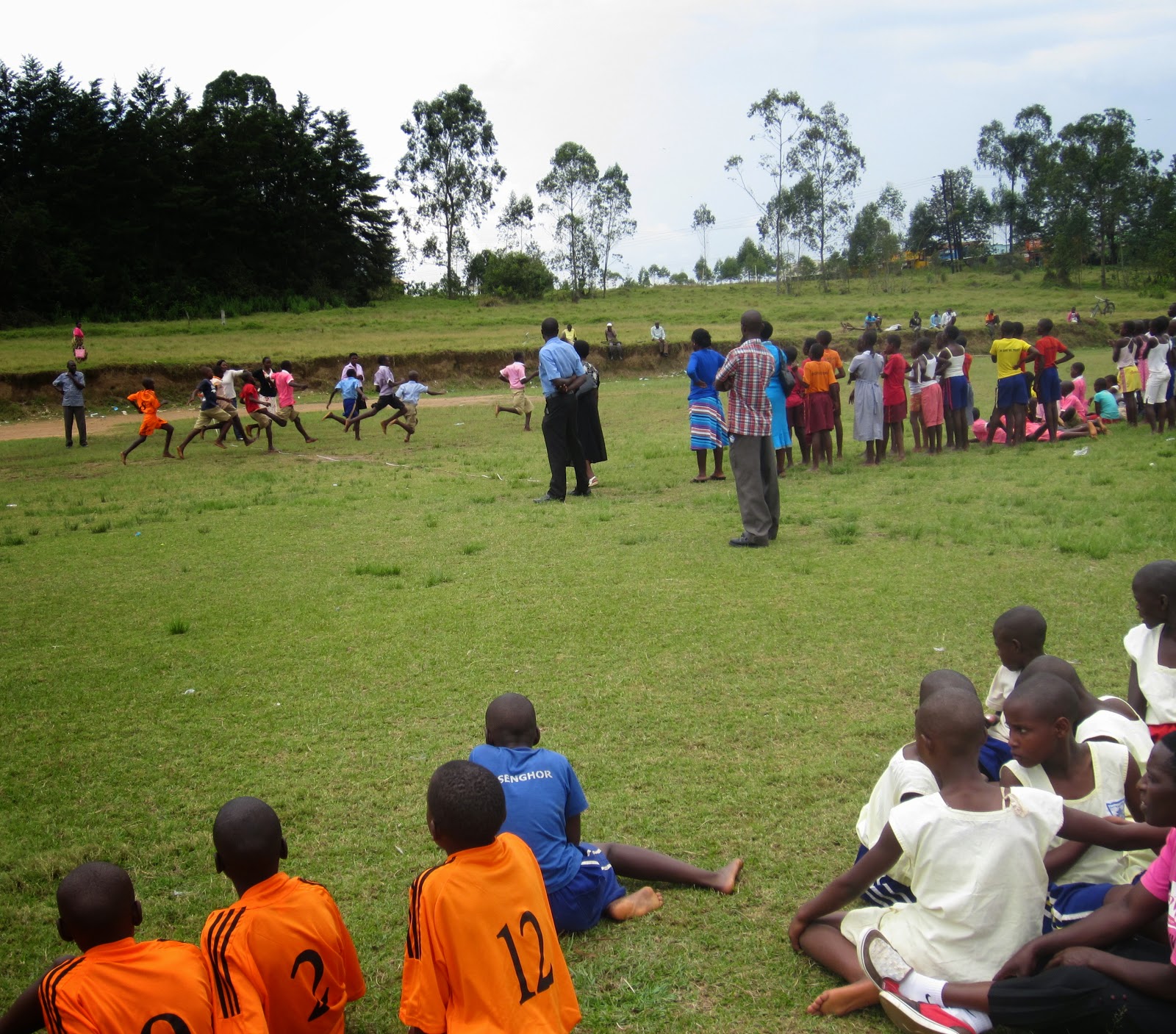
The field day consisted of the top athletic pupils from schools around the sub-county competing for the purpose of forming a county team from the best performers. The economic difference amongst the schools, even within such a small area, was readily apparent from the moment Kris and I walked down to the college’s pitch. While my pupils wore their school uniforms when not competing and stripped down to tank tops, biker shorts, and even boxers to race – normally not at all acceptable in Uganda – pupils from other schools had matching sports uniforms, some even with personalized names and numbers on the back. 

Two of my pupils, Peace and Sandrah.

Some uniformed pupils from other schools watching their classmates compete.

Despite the outward differences, every pupil was extremely excited and wound up to compete. During the longer races, which were staked out with sharpened wooden sticks around the pitch to approximate a track, the pupils not competing ran wildly back and forth, yelling and screaming and cheering their classmates on. Of course, aside from having a day off of school and being allowed for once to burn off all of their youthful energy, a lot of this probably had to do with the fact that every teacher was feeding their pupils a steady stream of glucose from large cans. When Gatorade’s not available, piling glucose into eager hands is the next best thing to keep your team's energy up!


Going all out - I can't remember the last time I saw someone give absolutely 100% of what they have.

Glucose for everybody!

When it got to the hurdle portion of the day, the purpose of the mysterious foam pieces, jerry cans, and sticks that Kris and I had seen in the library became clear. The foam pieces assembled to become kid-sized hurdles and, since there weren't enough, hurdles were also made by sliding a stick between the handles of two jerry cans. The athleticism of the kids was unbelievable, especially since most of them didn't have the chance to train for any of these events! Living a life outside as a child certainly has its benefits.


Towards the end of the day, we moved to a different pitch, albeit still one without shade from the relentless sun. Many of my pupils from the school who weren’t participating had shown up once school had let out for the day. In the oppressive heat, they were practically salivating over the icees one entrepreneurial woman was selling out of a cooler under the shade of an umbrella. Two of my bolder girls, Gift and Lucky, came up to Kris and me to ask for money to buy icees. While Kris and I debated, all of my 40 pupils present slowly crept up around us, waiting for our decision. Even though we have been actively fighting against the image of Americans who come in and throw money everywhere, I was indecisive because it felt like such a universal moment to me, being a teacher at a sporting event, supporting and cheering on my pupils. Kris and I decided that since we felt like a part of the community now, and it was something we would do in the U.S. without thinking, that we would go ahead. Thrusting a 5,000 shilling note into a prefect’s hand, I instructed him to bring me back the change. The herd of kids sprinted away, swarming the poor saleswoman, and trickled back one by one to sit down next to us again, slurping away on their frozen treats. The prefect, Dan, carefully monitored the purchases to ensure that each child received only one icee. Once everyone had gotten their share, he brought the change back to me. I stared at the crumpled bills still remaining while my pupils chattered happily around me. The price to buy 40 children icees? About 75 cents.

Lined up on the raised edge of the pitch, our feet dangling, Kris, the kids, and I watched the next event. The javelin, shot put, and discus throw were clearly alien to most of the pupils. Patiently waiting in line for their turn, their names written on a piece of paper attached to a twig that would mark their farthest shot, they listened to their teachers explain how to use these colonial-area throwbacks. Laughter abounded as each kid tried as hard as they could to chuck each of them as far as possible.


The final events of the day were all about jumping. First up was a long jump in which the participants had to carefully follow a prescribed routine of steps and hops while approaching the sand pit. 

Still maintaining proper feminine decorum in a school uniform dress.


Then, the teachers set up a high jump and explained to the pupils how to properly jump and land. Seeing how the landing area was just a small pile of old hay, the kids were understandably reluctant to begin at first. To Kris and I, the setup looked less like something to be encouraged and more like something an American parent would freak out about finding their kids playing with in the backyard. However, Uganda is certainly not the land of helicopter parents! 


After a few repetitions of the teachers running up to the rope and demonstrating how to leap over it (without actually doing it themselves), one brave pupil stepped up. Once she successfully did not die, the rest of the children lined up eagerly and once again proved that they were up to any task – and that American parents are, on the majority, vastly overprotective.

That's my pupil, kicking butt in her pink dress!


It was a really fun, very different day and an experience both Kris and I were so glad to have shared with my pupils. Unfortunately, the experience also ended up burning the absentminded two of us to a crisp. (Sorry Moms!) In the staff room the next day, my teachers were shocked by my striped appearance, and even more appalled when I told them that my burns were from the sun. “The sun did this to you?!? You are so fragile!” 

It's already starting to tan here, but I was quite stripey for a few days!

When I actually think about the fact that the life-giving rays of the sun can cause me severe physical harm, it really is ridiculous. Right up there with invading aliens who are killed by water. Once my counterpart got over her shock, however, for the rest of the day she delighted in showing everyone how my red, burnt skin would turn white when she pressed down on it. Good times. 

Despite the resulting discoloration, this relaxed, fun, unique day made something in me click. Uganda is finally starting to feel like a home. Whether it’s rooting on my pupils, laughing with my teachers, being welcomed back by my neighbors after a long time away, or feeling the warm grass on my bare feet as I run a jerry can outside for the milkman to fill, I am starting to find a bit of that elusive sense of comfort.


"Home isn't a fixed place; it's an earned idea, a belonging, a growing sense of knowing where you are in relation to everyone else, and it's the knowledge of the truth that everything exists in relationship."
- South African immigrant to the U.S.