Welcome to our home as married Peace Corps education volunteers in Uganda! This MTV-style Cribs video was filmed by our friend and fellow PCV, Matthew Dahlberg, with special guest appearances by more friends/fellow PCVs, Carmen and Amanda.
Tuesday, July 21, 2015

Saturday, July 11, 2015
The Amazing Race Comes to Bushenyi!
A new group of Health and Agriculture trainees arrived in Uganda two
months ago. Like my Education cohort did, they completed their “Boot Camp” and have moved
on to stay with host families for intensive language training. The Southwest
group, about 9 volunteers in total who will be placed in the Runyankore/Rukiga
language region, is staying in Bushenyi
Town Uganda ! If
you’re not familiar with The Amazing Race, it’s reality TV show where teams of two race around the world to complete various tasks in different countries. It also turns out to be a great concept to
adapt for language learning.
Part of Peace Corps language training is known as “community
experience." This involves the trainees being set free in the local area in which they are staying and told to use the language tasks that they have been
learning. They are supposed to practice greeting, ordering food, haggling, finding
transportation, and, of course, talking up the Peace Corps with whomever they can find. It sounds fairly simple but in reality, as any language teacher
knows, that's a monumental assignment for a student, especially when they're an adult. The uncertainty, fear, and exhaustion of being in a new culture coupled with attending classes eight hours a day, six days a week means that most students are too reluctant, too nervous, or just plain too tired to take their own
initiative to practice their new language in a real-world context.
One way to combat this is to give learners more specific assignments to complete.
Creating guidelines and a safe, predetermined space to practice mitigates a lot
of the anxiety adult learners can feel. After all, when you’re speaking a brand new
language to native speakers, you really do feel like a child again a lot of the time! Add this idea to the fact that, when you’re American, you will naturally turn these tasks into a competition, and The Amazing Race: Uganda is born. The prize?
Homemade baked goods, of course, from a selection of the six I’m able to make here.
There are few things a Peace Corps trainee dreams about more than food (sorry,
friends and family – they still love you).
So, each week, Kris has been traveling around Bushenyi Town
and speaking to our Ugandan friends, asking them to provide tasks and interact
with the trainees in local language as part of the Amazing Race. In a fringe benefit that we weren't expecting, the locals have absolutely been loving it. It means a lot to them to see foreigners
really making an effort to get to know who they are while caring so obviously about their language and their culture.
Plus, it’s funny to see a bunch of Americans running around frantically, trying
desperately to remember the word for bananas.
This week, the race came to our trading center and schools!
Kris set up tasks around the area and I waited at my primary school while
Kris “released” the teams five minutes apart in Bushenyi Town

The first clue:

You have to haggle for almost everything here, including transport, so 10,000 shillings can go fast if you're not good at bargaining!
Second clue:

Those might have been our clothes that the trainees were washing...
Third clue:

Immaculate has actually seen the Amazing Race, so she was super excited!
After talking to Immaculate, the trainees were given a fourth clue directing them to my primary school. Upon arriving, they had to enter the Primary One or Primary Two classroom and be taught a song by the pupils and teacher. My headteacher and deputy headteacher were there to greet them when they arrived, bemusedly shaking hands and directing the sweaty Americans to the correct classroom block.
Each class presented its own challenges and advantages. Hope, the P1 teacher, was very strict about pronunciation, but she had written down the song for the trainees and allowed them to sit in the back with the class.


Such good sports!
It is a simple song that the teachers sing with the little ones when it's time to practice handwriting:
Kampandiike gye
Kampandiike gye
Kampandiike kurungi
Ndyaba karaani!
Let me write well
Let me write well
Let me write so very well
I will be a secretary!
Its length didn't make it any less difficult to sing in front of a class, however! But with the promise of baked goods on the line, the trainees performed beautifully.

Receiving their next clue from the primary school secretary.
The last clue involved a trip to the banana stand clear at the other end of the trading center. The volunteers had to haggle the price down to a reasonable 2,000 shillings and hope that they had enough left out of their 10,000 shillings to make it back to Bushenyi Town!

The set aside items might also have been from our grocery list...
It all ended up in a sprint to the finish line between two of the four teams, with one victoriously claiming their prizes of no-bake cookies and coffee cake. Hopefully, however, everyone also left with a better understanding of how to navigate around Uganda, a greater proficiency in Runyankore, increased confidence, and some good, albeit ridiculous, memories.
"That was fun, but it wasn't fun."
- JJ from the Amazing Race
Monday, July 6, 2015
When Help Is a Four-Letter Word
I’ve gotten into the habit of locking the door and drawing
the curtains whenever I get home. In the recesses of my house, cut off from the
world, I’ve begun to consider the vastly complex issue of a deceptively simple
word – “help.” I never realized it before, but as a society, we attach so many
intense labels to the word help. The truly astounding part is that which label we
choose to use depends on the context of the word – if the help is being given
or received. In general, if we think of help in terms of being given, it is
almost sanctified. It is a virtue to aspire to, a holy, spiritual quality of
someone good and pure and admirable. If we think of help in terms of it being
received, that picture changes. We associate the word with a sense of pity
instead; needing help is something almost shameful, an issue that we distance
ourselves from with images of homeless vets in soup kitchens or barefoot
children in Africa . But on either end of the
word, the labels attached to help are toxic and untrue. We’ll always fall when
we put ourselves on pedestals of self-righteousness and, if we attach judgment
to receiving help, we’ll also, however unconsciously, attach judgment to giving
it. Help needs to come from a place of empathy, not pity.
We need to be able to acknowledge our own dark places, our
own imperfections, and allow others to see them - we need to be able to receive
help in order to give it. This is the journey that I’m on now. When you don’t
want to think of yourself as the receiver, it’s so easy to shut yourself off
from everyone else trying to help – hit silent when the phone rings, neglect
your inbox, put in your headphones when someone’s knocking at the door. But I have started to realize that when I
close my door to others, when I don’t let them in, I can’t get out either. That
closed door is not a one-way barrier to help. One of the most important things
I’m learning here is how to keep my door open, to ask for help, however small,
without shaming myself for getting it or telling myself that next time I’ll be
able to get through it alone. Because I’m not alone. We’re not alone. No one is
meant to make it through this world by themselves. Not reaching out to your
family, your friends, your community, or health care professionals doesn’t make
you strong, doesn’t make you tough, and certainly doesn’t make you better. In
fact, it almost makes you stupid, and it does make it harder for you to reach
out to others in an effective manner. I tried to make my life about helping
without even realizing that I shrank from applying that word to myself as a
receiver – and I don’t think I’m the only one. In these two years of Peace
Corps, I never thought one of the most important things I’d learn in trying to
help was how to ask for it and accept it while still feeling strong,
still feeling enough, still being who I wanted to be. In order to truly be able
to help, I now know that I have to learn how to be helped.
We must relabel “help” as normal, not something that is only
required in extreme situations of poverty, natural disaster, or disease but
rather something that everyone is able to give and get constantly. In fact, we can’t
get through life without doing both. When we lock our door to others trying to
get in, when we refuse to receive help, it traps us as well, making it so much
more difficult when we want to give help to see who is on the other side and what they really need. It makes us vulnerable to keep that door open, to allow
people to see inside, but it also frees us to help and be helped. If we want to really, truly help, we have to
stop letting help define us, in one way or the other, and instead stand in our
open doorways, exposed but present.

"If we’re going to find our way back to each other,
vulnerability is going to be that path. And I know it’s seductive to stand
outside the arena and think, I’m going to go in there and kick some ass when
I’m bulletproof and when I’m perfect. And that is seductive. But the truth is
that never happens. And even if you got as perfect as you could and as
bulletproof as you could possibly muster when you got in there, that’s not what
we want to see. We want you to go in. We want to be with you and across from
you. And we just want, for ourselves and the people we care about and the
people we work with, to dare greatly."
- Brené Brown
Tuesday, June 30, 2015
ZaaAAAanzibar!
Over term break, Kris and I got the chance to meet up with our friend Quinn (who I've known for over two decades now) in amazing, magical Zanzibar! Zanzibar merged with Tanganyika in 1964 to become the United Republic of Tanzania and is also known, justifiably so, as the Spice Islands. It's a fascinating place with a complex history - Persian, Omani, Arab, Portuguese, and Indian influences can be seen everywhere, side by side. Its Bantu-speaking people are mostly Muslim, with about 98% of the population practicing Islam, and while there are a decent amount of Muslims in Uganda, it was fascinating and enlightening to visit our first Muslim country.
The architecture, food, and markets were beyond phenomenal and like nothing any of us had ever experienced before. The call for prayer from a minaret outside of our Stone Town apartment marked the rhythm of our days as we explored the narrow alleyways and small shops tucked into every corner.

The view from the balcony of our Stone Town apartment.


Relaxing on our porch while the smell of cooking and spices wafted up around us.

Heading out...with a vampire!

"Sundowners" at a nearby restaurant overlooking Stone Town.


Stone Town's gorgeously carved doors are famous for their intricate detail.

Cheetah's Rock was without a doubt one of the highlights of our experience. It is a sanctuary in Zanzibar founded by a woman who rescues both wild animals and unwanted zoo animals (apparently, when baby animals get older, they are often killed by zoos which don't have the space or money to keep them). She uses only positive reinforcement to train the animals - she has never once hit, punished, or drugged them in any way. Even when she shipped her animals from Spain to Zanziber, she spent months training with them, having the animals practice entering shipping crates so they would remain calm on the flight. We got to enter the cage of every animal, except the hyena, and feed and/or touch all of them while we heard their incredible stories of survival. I felt like a kid in the coolest dream ever the entire time.


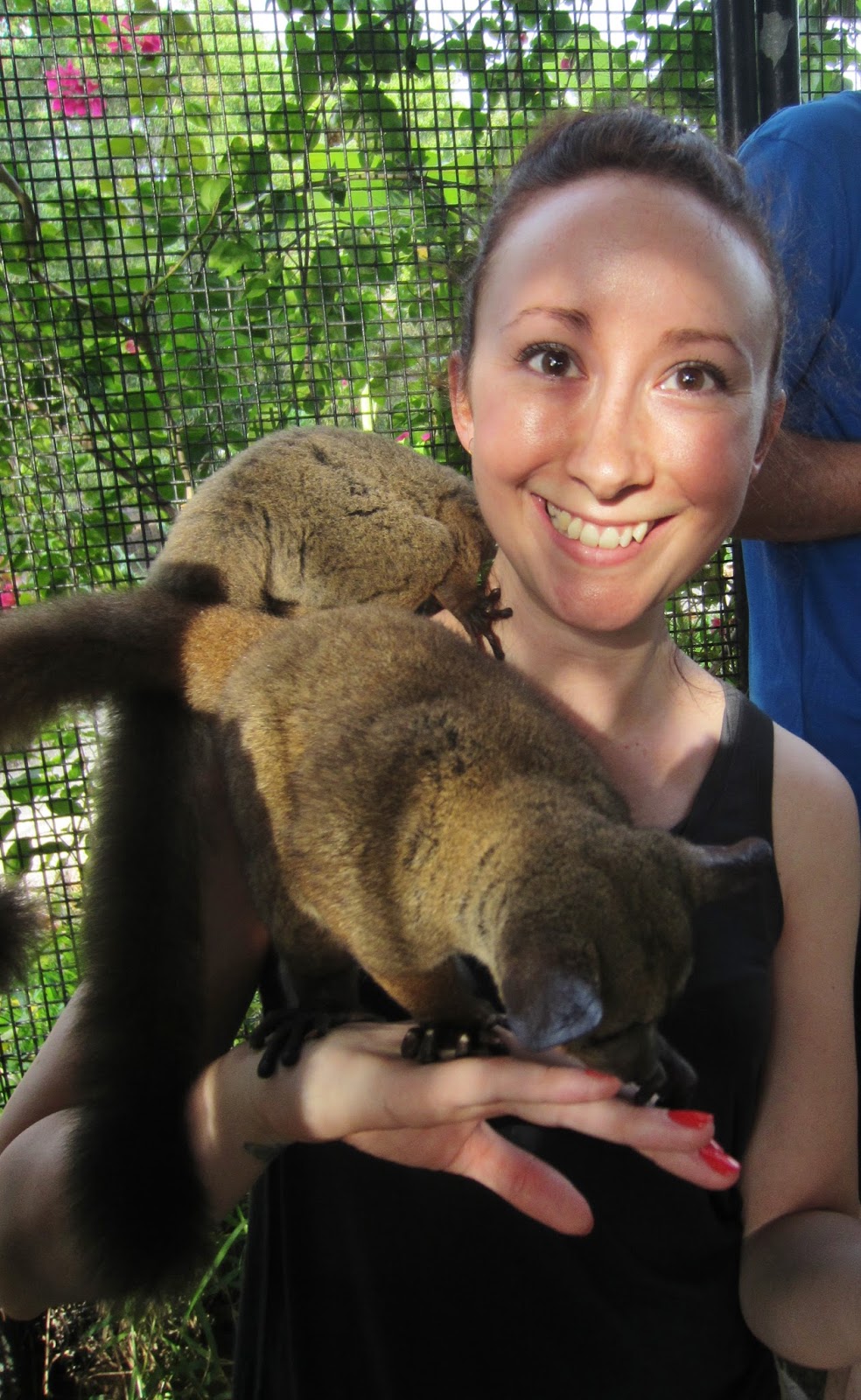


My heart was absolutely racing as I fed Aslan, the white lion. It was an incredible feeling!

And to top off the amazing afternoon - champagne with a cheetah!


Tyson, just like all the other animals, loved Kris.
We also got the opportunity to go on a spice tour to see the locally-grown crops, ending with lunch at a local woman's house.


Nutmeg - apparently the outer red part that you can see here is used to make things like pepper spray!

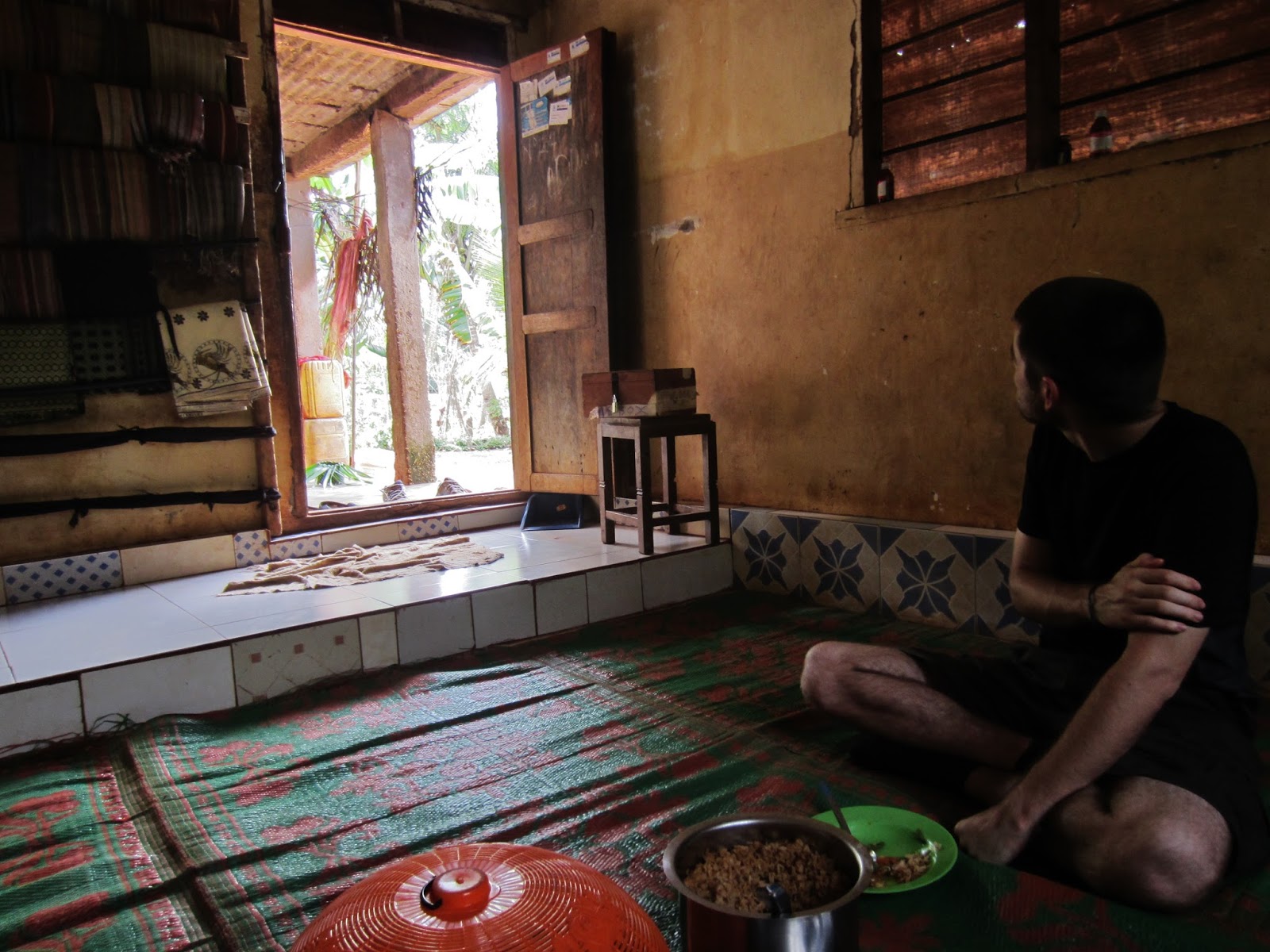


Everyone thought that Quinn's name was Queen, so the crown our guide made her worked perfectly!
Quinn brought champagne from the U.S. and we had a refrigerator in our apartment, so we celebrated her birthday in style! Just look at the condensation on those glasses...

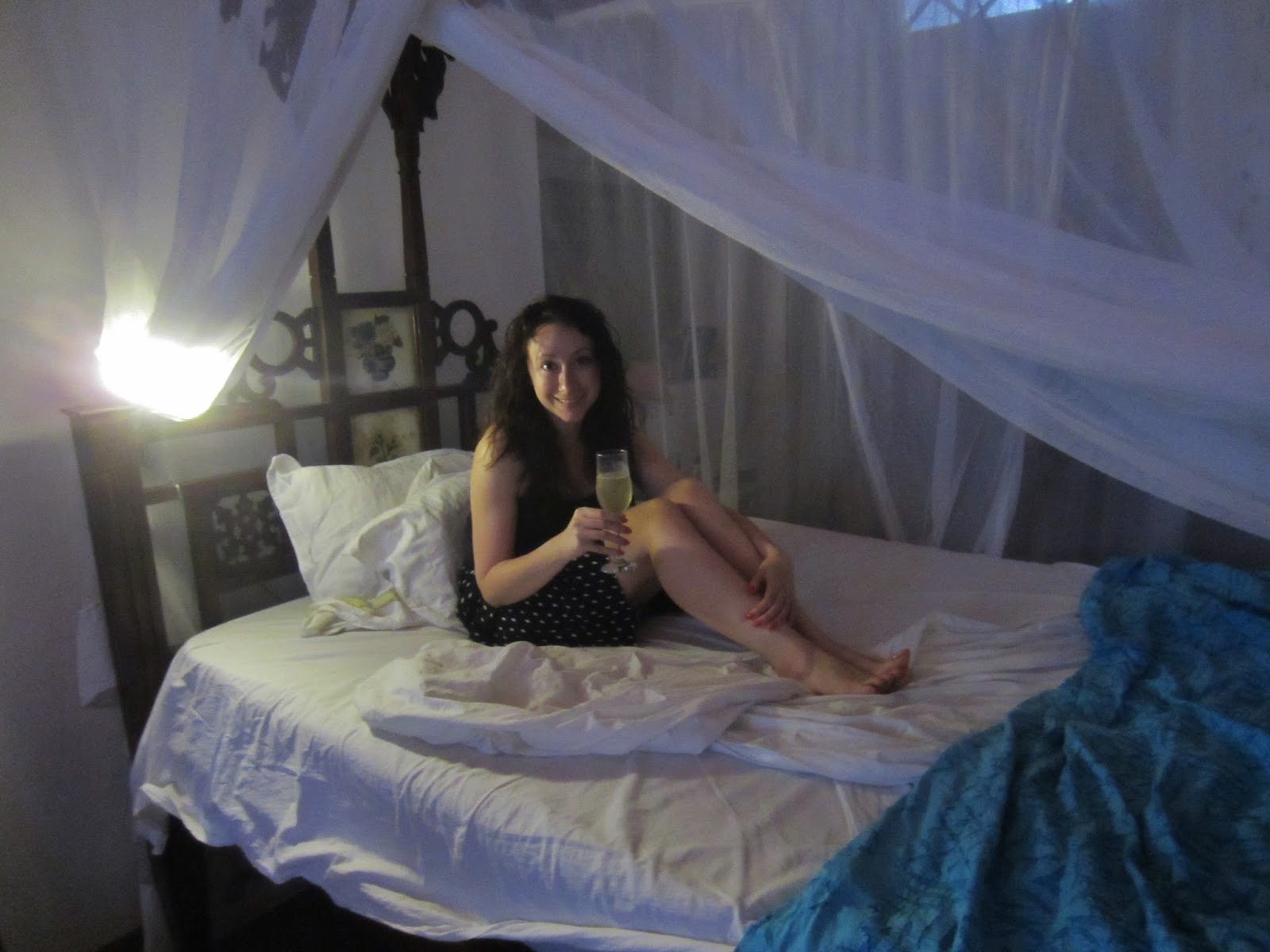


Birthdays are for embarrassing, no?

The owner of the restaurant near our apartment was nice enough to make and surprise Quinn with this cake on her birthday - for free!
The next night we had dinner at the night market, a local market full of fresh-caught seafood.


A delicious dinner topped off with a glass of sugarcane juice.

And ending with a Snickers, Mars, and chocolate pizza!
For the second half of our trip, we headed to the east coast of Zanzibar to stay on the edge of a coral reef. Quinn, Kris, and I all voted the Indian Ocean our favorite ocean by far - clear, beautifully blue, and somehow scented with a delicate, gentle floral aroma.


Many of the locals were harvesting seawood when we arrived - a friend we met at the hotel told us that this time of the year was exciting and busy for mother, grandmothers, and children.


Behind us is The Rock Restaurant - balanced on a rock in the ocean!
While there, Kris and I went snorkeling - Quinn, unfortunately, was feeling too sick to join us that day. We went with a local man who called himself "Captain Chicken," who has been sailing in these waters for decades. Kris and I walked about a mile out to the ocean to reach his dhow at low tide. He took us to the clearest water I've ever seen and I taught Kris how to snorkel for the first time (sorry, he would like me to point out that he's snorkeled in a pool before. I would like to point out that doesn't count). We saw some incredible fish; it felt like a scene out of Finding Nemo! An underwater one, that is, not one of the ones at the dentist's office.


Relaxing with a good book later in the day - some parts of our friendship just haven't changed.

While we were reading, a monkey came by and literally jumped on our bed!

It was a red colobus monkey, and a curious one at that! Red colobus monkeys can only be found in the archipelago of Zanzibar.


Trying to figure out how to eat our seafood.

After bidding Quinn a teary goodbye, Kris and I head up the coast to spend a few more days of vacation together before heading back to work in Uganda. We stayed at a small, Italian-run hotel that was incredibly cheap because we were there during rainy season. The chef was incredible and the beach right in front of our door; we holed up there for the rest of our time.


Haggling for souvenirs with some actual Maasai on the beach. One of them drew a box in the sand and he and I sat down on either side of it. He would write a number, then I would laugh and write a much lower number. He would look offended, then we would repeat the process.
On our last afternoon, Kris and I went for one final swim in the Indian Ocean. The sun was setting and a quintessential rainbow arched over a dhow moored not too far from land. I held Kris's hand in the water and watched as a combination of the sun's last rays and happiness made his face glow. I basked in the scene, with the rocking dhow illuminated gently behind him and the rainbow spread out breathtakingly above it. I didn't take a picture, but it was a memory I will never forget for I knew, as the warm water cradled us and the breezy, floral scent of Zanzibar caught my nose, that it was a perfect moment. It was silly and happy and open and beautiful. Then we went and ate a mountain of sushi. Good day.


I'm not sure, but it seems like the purpose of this airplane safety card is to point out how flexible ballerinas are.
When we arrived in Entebbe Airport, we had to wait in line to get our temperatures taken. As I handed my health card and my passport to a motherly woman at one of the tables, she glanced at my work permit and welcomed me home in local language. I beamed and replied in the same language; it was an amazing end to a magical vacation, and it was good to be home.
"I walk out, I see something, some event that would otherwise have been utterly missed or lost; or something sees me, some enormous power brushes me with its clean wing, and I resound like a beaten bell."
- Annie Dillard
Subscribe to:
Posts (Atom)